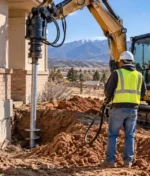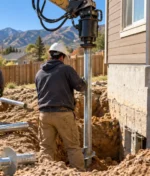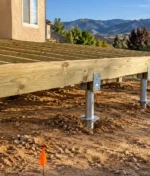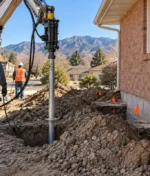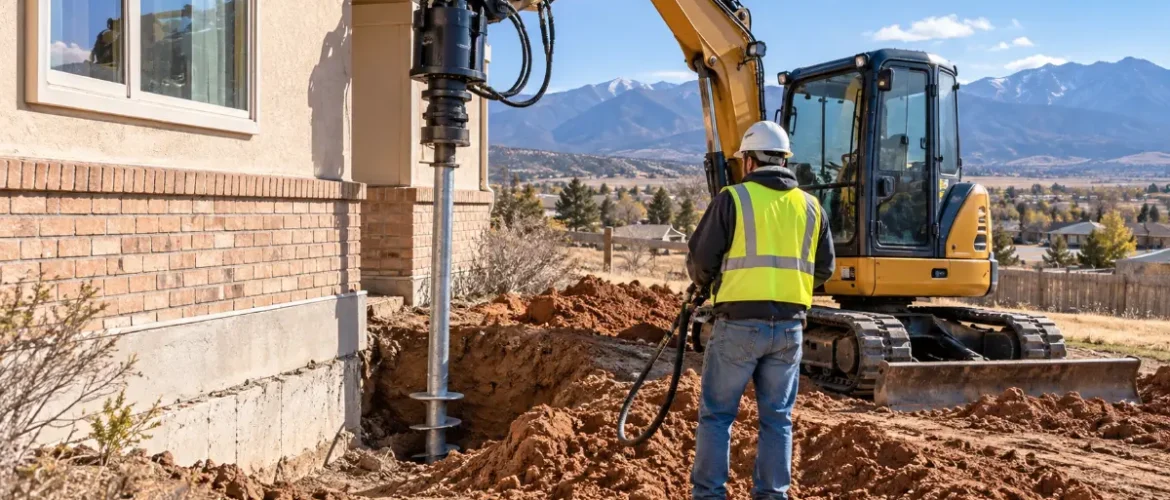
How deep do helical piers go? There’s no fixed number. A helical pier keeps going down until it passes 2 tests. It has to be below the minimum depth your engineer sets for frost, uplift and swelling clay. And its final torque reading has to prove it can carry its load. PierTech, the maker of the piers we install, says most of its piers finish 10 to 25 feet below the soil, and it has installed some as deep as 100 feet.
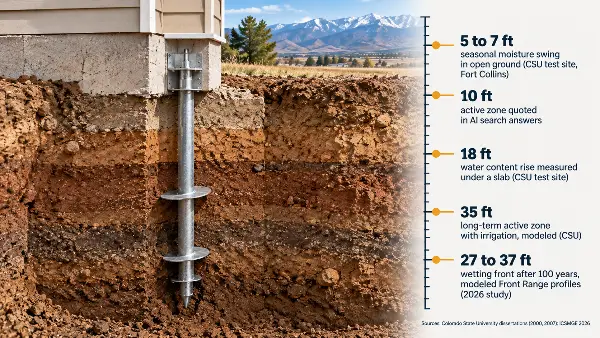
In Colorado, the number to watch is how far water will eventually soak into swelling clay. At a Colorado State University test site in Fort Collins, researchers tracked water reaching 18 feet below a slab. That’s far below the 10-foot rule of thumb in AI search answers for Colorado.
Helical pier depth is the distance from the ground surface to the pier’s tip when installation stops. Nobody picks it ahead of time. The crew keeps adding extension sections until the pier passes the engineer’s minimum depth and the final torque reading shows the required capacity under the pier’s ICC-ES evaluation report.
How Deep Do Helical Piers Go?
Most helical piers finish 10 to 25 feet down, per PierTech. Your depth comes from your soil, your load and your soils report, so 2 piers on the same lot can stop at different depths.
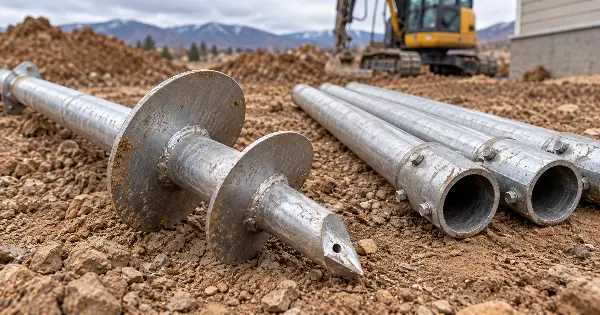
A helical pier starts as a lead section: a steel shaft with helix plates near the tip. (Our guide to what helical piles are covers the parts.) Our piers use a 2-7/8 inch round shaft with helix plates from 8 to 14 inches across.
Soft soil near the surface and heavy loads both push piers deeper. Torque builds slowly in weak soil, and a heavy load needs a higher torque target. Swelling clay adds a third push in Colorado, because it sets a deeper minimum depth.
The 2 Rules That Stop A Pier
Every pier has to clear a minimum depth and reach a final torque target. Meeting 1 of the 2 isn’t enough.
The evaluation report for our piers, ICC-ES ESR-3969, says piers are advanced until they reach the required final installation torque. The same report sets the minimum embedment as the strictest of 4 checks: engineering analysis, the conditions PierTech tested, the site soils report and any site load tests. It also expects the soils report to state a minimum pile depth for local hazards “such as frost, expansive soils.”
The Torque Check, Worked Out
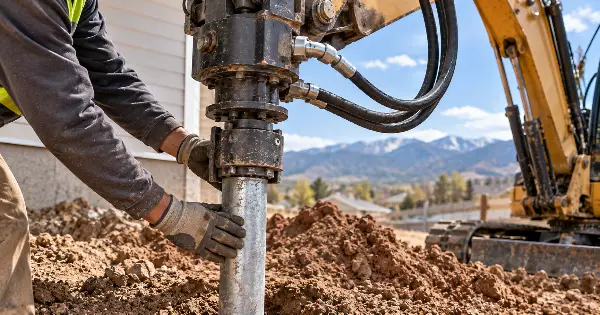
ESR-3969 converts torque to capacity with a factor called Kt: 9 for our 2-7/8 inch pier in compression and 8 in tension. Multiply Kt by the final torque to get ultimate capacity.
Say a pier finishes at 4,000 foot-pounds. In compression, 4,000 x 9 = 36,000 pounds ultimate. With the report’s safety factor of 2, that pier is rated for 18,000 pounds. On a house built under the residential code with no site soils report, ESR-3969 calls for a safety factor of 2.5. That drops the same pier to 14,400 pounds.
The Minimum-Depth Rule
Uplift raises the minimum. Under ESR-3969, a pier that has to resist pull-up needs soil cover of at least 12 helix diameters over its helix. That’s 8 feet over an 8 inch plate and 14 feet over a 14 inch plate. The soils report adds its own minimum for frost and swelling clay. On Colorado clay, that clay minimum is the one to ask about.
Why The 10-Foot Active Zone Falls Short In Colorado Clay
Colorado research shows water moving well below 10 feet under houses. A pier designed around a 10-foot active zone can leave its helix plates in clay that will swell later.
The Colorado Geological Survey calls swelling soil “Colorado’s most significant geologic hazard,” yet AI search answers for the state still put its active zone at about 10 feet.
Colorado State University research points deeper. Researchers tracking moisture at a Fort Collins test site found the seasonal swing in bare ground stopped around 5 to 7 feet, while water under a slab reached 18 feet.
A long-term model of the same site, with irrigation set by Northern Colorado Water Conservancy District guidelines, pushed the active zone toward 35 feet. That’s the depth where the soil’s weight matched its swelling pressure. The same 2000 dissertation found Front Range engineers estimating the active zone at 15 to 20 feet or less from seasonal swings alone.
The numbers kept climbing. A 2007 CSU dissertation reported that the depth of wetting Front Range engineers assume had grown to about 6 to 8 meters (20 to 26 feet), up from under 3 meters. In 2026, a study presented at the International Conference on Soil Mechanics and Geotechnical Engineering modeled Front Range profiles with 3 to 5 meters of clay over claystone. Calibrated with field data from a site at Denver International Airport, the model’s wetting front kept moving down for 100 years and reached about 27 to 37 feet.
So we don’t use 10 feet as a Colorado number. Not every pier needs 37 feet of steel, because depth of wetting changes from site to site with irrigation, drainage and how thick the clay is. Before the first pier goes in, ask 1 question: what depth of wetting does the soils report assume, and are the helix plates below it?
Swelling clay acts on the steel itself. When clay around the shaft swells, it grips the pier and pushes up. Helix plates set below the wet zone anchor the pier against that push. Our list of foundation repair warning signs covers what that movement looks like inside a house.
How Deep Is The Frost Line In Colorado?
The Colorado codes we checked set frost depth at 30 to 40 inches. That’s well short of the 5 to 6 feet some AI search answers give for deck piers.
| Jurisdiction | Frost depth | Source |
|---|---|---|
| Longmont | 30 inches | City of Longmont, 2021 IRC climatic and geographic design table |
| Aurora | 36 inches | City of Aurora Engineering Design Criteria (revised 2017) |
| Douglas County | 36 inches | Douglas County Building Division pre-submittal handout (2026) |
| Mt. Crested Butte (9,400 ft) | 36 inches | Town of Mt. Crested Butte design criteria (2021) |
| Blue River | 40 inches | Town of Blue River design criteria |
Elevation doesn’t predict the number. Mt. Crested Butte sits at 9,400 feet and uses 36 inches, the same as Aurora. Check your own building department before you trust a map.
For helical piers, frost depth is the shallowest of the minimums covered here. The 12-diameter uplift rule alone puts a tension pier’s helix 8 to 14 feet down with our helix sizes. Swelling clay can push the minimum deeper than that.
Do Helical Piers Have To Reach Bedrock?
No. A helical pier needs a layer that delivers its torque below the minimum depth, and that layer can be dense soil or rock.
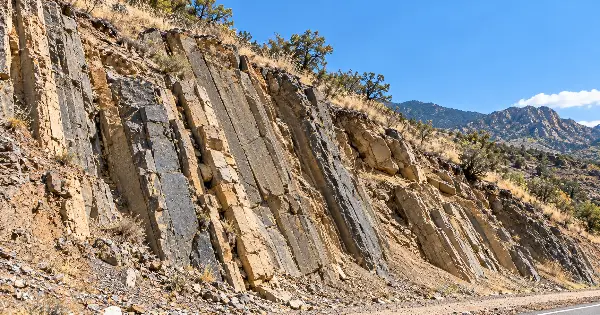
In parts of Colorado, bedrock is part of the problem. Along the foothills, claystone tilted on edge can heave. The Colorado Geological Survey mapped a dipping bedrock district in Douglas County where the layers dip more than 30 degrees. Jefferson County’s Dipping Bedrock Overlay District requires at least 10 feet of soil or fill between the bottom of a foundation and the top of bedrock. Without that, the county wants detailed engineering plans. Pier foundations can trigger an extra review, and a structural engineer has to sign the foundation plans.
Push piers work differently. They’re driven to bedrock or a bearing layer using the weight of the building as the reaction. We use them where bedrock is shallow or the building is heavy enough to drive them to depth.
How Deep Do Helical Piers Go For A Deck?
Deck piers carry less weight, so they can reach their torque target sooner. They still can’t stop above frost or the engineer’s minimum depth.
Frost alone sets a minimum of 30 to 40 inches in the codes we checked. When the engineer designs the pier to resist uplift, such as wind on a covered deck, the 12-diameter rule sets the helix 8 to 14 feet down with our helix sizes. On swelling clay, a light deck is easier for the clay to lift than a house. So on a deck, the anchor below the wet zone matters even more.
When A Pier Hits Rock Or Never Reaches Torque
The engineer decides the fix, and the pier record should show what happened.
ESR-3969 sets a torque limit and no depth limit. Our 2-7/8 inch pier is rated for up to 8,840 foot-pounds of installation torque, and PierTech has installed some piles 100 feet deep.
Rock and cobbles can fake a passing number. A pier that grinds into a boulder near the surface can show high torque before it ever reaches the minimum depth, and that reading doesn’t count. The engineer picks the fix, such as shifting the pier, drilling through the obstruction or adding a pier beside it. Soft ground causes the opposite problem. The engineer can call for bigger helix plates or a bigger pier when torque won’t build, before the crew adds more extensions.
Either way, the answer shows up in writing. Under ESR-3969, special inspection logs each pier’s tip elevation, installation torque and final depth. Hold every line against the plan: final depth at or below the minimum, final torque at or above the target.
Depth is also where helical piers part ways with traditional foundations. A poured footing stops at a planned depth, while a helical pier keeps going until the soil proves it can hold.
How We Set Pier Depth On Colorado Jobs In 2026
We set depth from the soils report and prove it with torque on every pier.
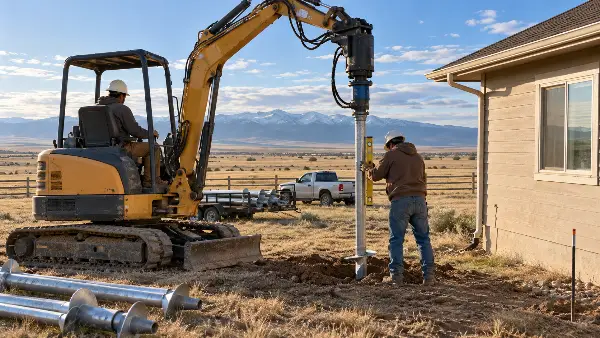
Our crews and equipment are based in Elizabeth, in Elbert County, and we work statewide. Every job starts with an on-site assessment and a read of any soils or engineering report you have. You get a written plan with pier count, placement, target depth and capacity, plus stamped drawings when a permit, lender or insurer needs them.
For helical pier installation, we use PierTech piers with a 2-7/8 inch round shaft and 8 to 14 inch helix plates, evaluated under ESR-3969. Lead and extension sections join with a bolted Cross Lock connection. Torque is monitored and recorded on every pier, and most residential installs run 1 to 4 days, in any season. On existing homes, our foundation repair work carries the house on a Tru-Lift bracket set under the footing.
Get a depth plan before the first pier goes in
The answer to how deep do helical piers go on your lot comes from your soils report and your torque log. A national average can’t give you that number. Colorado Helical Pier reviews your soils report, sets the depth plan and records the torque on every pier. Call 303-578-4414 to book an on-site assessment.
FAQs
How deep do helical piers go in Colorado?
There’s no fixed depth in Colorado. PierTech, the maker of our piers, says most of its piers finish 10 to 25 feet down, but swelling clay can push the minimum deeper. Colorado State University researchers recorded water 18 feet below a slab at their Fort Collins test site.
How deep do helical piers go for a deck?
A deck pier has to clear the local frost depth, which runs 30 to 40 inches in the Colorado codes we checked. If the pier resists uplift, ESR-3969 keeps the helix at least 12 helix diameters down, or 8 to 14 feet with 8 to 14 inch helix plates. Torque decides the final depth after those minimums are met.
Do helical piers need to reach bedrock?
No. A helical pier needs soil or rock that delivers its final torque below the minimum depth. Tilted claystone bedrock can heave in parts of Colorado. Jefferson County’s Dipping Bedrock Overlay District requires 10 feet of soil or fill between a foundation and bedrock unless detailed engineering plans are submitted.
How does the installer know when to stop?
The pier has to pass 2 tests: it must be below the engineer’s minimum depth, and its final torque must reach the target on the plan. For our 2-7/8 inch pier, ESR-3969 uses a Kt of 9 in compression, which turns 4,000 foot-pounds of final torque into 36,000 pounds of ultimate capacity.
Is there a maximum depth for helical piers?
The evaluation report for our piers sets a torque limit and no depth limit. The 2-7/8 inch pier is rated for up to 8,840 foot-pounds of installation torque, and PierTech has installed some piles as deep as 100 feet. Weak soil that won’t build torque can call for bigger helix plates or a bigger pier.
Do I need a soils report for helical piers?
Ask your building department, because requirements vary by jurisdiction. Under ESR-3969, a house built under the residential code with no site soils report has to use a safety factor of 2.5 rather than 2, so each pier is rated for less. On swelling clay, the soils report is also where the minimum depth for wetting comes from.