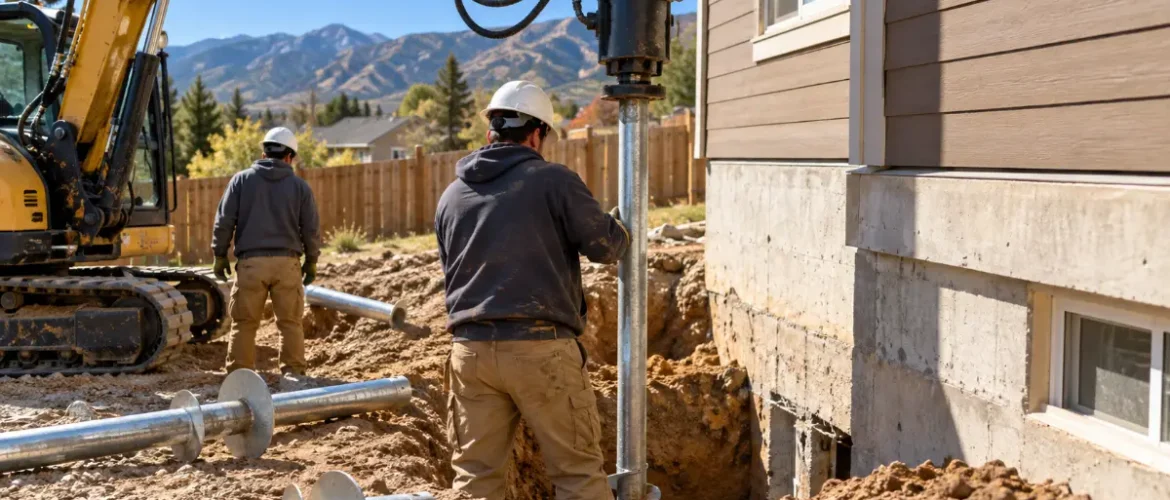
How much weight can a helical pier hold? ICC-ES report ESR-3969 covers the 2-7/8 inch PierTech system we use. It allows up to 27,900 pounds per pier on a foundation repair and up to 39,780 pounds on new construction. Those are allowable loads, the numbers engineers design to. The soil’s ultimate capacity at full torque is 79,560 pounds, double the new-construction figure.
The report, reissued in January 2026, rates a pier at the lowest of 4 parts. That changes the answer. Ask about the bracket before the helix plate. For a repair, the bracket under your footing sets the ceiling.
How Much Weight Can A Helical Pier Hold, In Pounds?
A helical pier holds as much as the weakest of its 4 parts allows: the bracket, the shaft, the helix plates and the soil. On the 2-7/8 inch system in ICC-ES report ESR-3969, that caps a foundation repair pier at 27,900 pounds and a new-construction pier at 39,780 pounds of allowable load.
Those are ceilings. Each pier still has to earn its rating in the ground, through the torque reading at the final turn. A pier that stops at lower torque gets a lower rating.
Ultimate Vs Allowable Capacity
Design to the allowable number. Ultimate capacity is the most the soil can take before the pier gives way. Allowable capacity is ultimate divided by a safety factor.
The report uses a safety factor of 2 for the torque method. It also follows Section 1810.3.3.1.9 of the International Building Code, which sets each pier’s rating by its weakest part. Turn the pier to the system’s 8,840 foot-pound limit and the soil’s ultimate capacity is 79,560 pounds. Divide by 2 and you get 39,780 pounds allowable.
Houses can lose some of that. Under the International Residential Code, when there’s no site-specific soils report, ESR-3969 divides by 2.5 instead. The same pier at the same torque then rates 31,824 pounds.
That’s why big numbers online need a second look. Ratings of 400,000 pounds or 500 tons belong to large-diameter commercial piles, to ultimate loads, or to whole groups of piers under a single structure. They don’t describe 1 pier under a house.
What Sets A Helical Pier’s Limit?
The weakest of its 4 parts sets it. The report checks the bracket, the shaft, the helix plates and the soil, and the pier’s allowable load is the lowest of the 4.
The Bracket
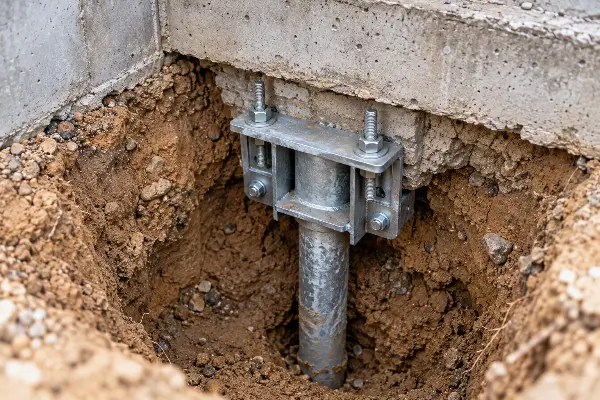
The bracket ties the pier to your structure, and it carries its own rating. This pier has 2 bracket options in the report. The side-load Tru-Lift bracket, used to underpin an existing footing, is rated for 27,900 pounds of push-down load and has no pull-up rating. The direct-load bracket, cast into a new footing, is rated for 43,530 pounds down and 33,940 pounds up. Both ratings assume concrete of at least 2,500 psi.
This is the part we’d point to first on any repair quote. Nothing below the footing can lift a repair pier’s rating past 27,900 pounds, because the bracket can’t carry more.
The Shaft
The shaft is 2-7/8 inch steel pipe with a 0.217 inch wall, made to ASTM A500 Grade B/C. With firm soil bracing it along its length, ESR-3969 rates it at 50,000 pounds of push-down load. Where the soil is too soft to brace it, or part of it stands above grade, the report lists lower ratings for that unbraced stretch.
The Helix Plates
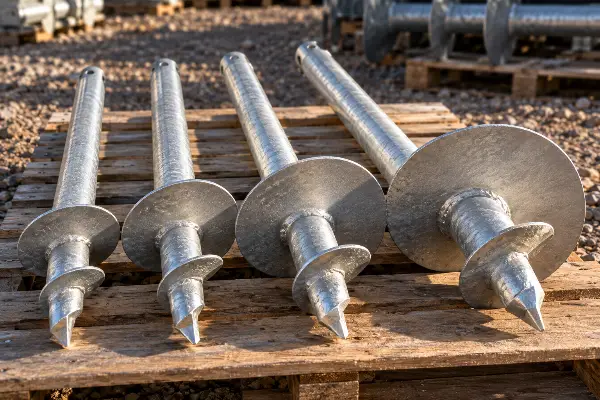
Each helix plate is 3/8 inch steel with a 3-inch pitch, in diameters from 8 to 14 inches. Table 3 of the report rates a single plate at 59,300 to 65,400 pounds of push-down load. That makes the plates the strongest part on paper. A bigger plate still helps, since it bears on more soil, but on this system the plate’s own rating is never the lowest of the 4.
The Soil, Read By Torque
The soil rating comes from the torque it takes to turn the pier at the end of the install. ESR-3969 multiplies that final torque by a factor called Kt, 9 for push-down and 8 for pull-up on this pier, then halves the result. A pier finished at 5,000 foot-pounds rates 22,500 pounds down. One finished at the 8,840 foot-pound maximum rates 39,780 pounds.
We record the final torque on every helical pier we install, so the soil rating is a measured number on each pier.
The 2026 Rating Table For A 2-7/8 Inch Pier
Here are the allowable push-down ratings ESR-3969 gives this system, part by part.
| Part of the pier | Allowable push-down load | Where ESR-3969 lists it |
|---|---|---|
| Side-load repair bracket (Tru-Lift) | 27,900 lb | Table 1 |
| Direct-load new-construction bracket | 43,530 lb | Table 1 |
| Shaft, braced by firm soil | 50,000 lb | Table 2(A) |
| Each helix plate, 8 to 14 inch | 59,300 to 65,400 lb | Table 3 |
| Soil at 8,840 ft-lb, with a soils report | 39,780 lb | Table 4 |
| Soil at 8,840 ft-lb, house with no soils report | 31,824 lb | Section 4.1.5 |
Read the table from the top. A repair pier can’t pass the bracket’s 27,900 pounds, no matter how the soil tests. On new construction, the soil sets the number.
At What Torque Does The Bracket Take Over?
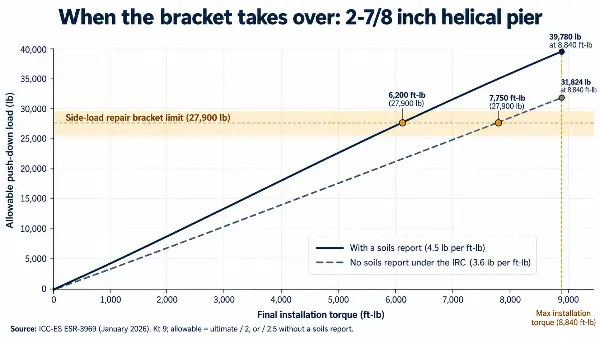
At about 6,200 foot-pounds of final torque on a repair pier with a soils report. Without one, under the residential code, it’s about 7,750 foot-pounds. Below those points the soil limits the pier, and above them the bracket does.
The math is short. With a soils report, each foot-pound of final torque is worth 4.5 pounds of allowable load (9 divided by 2). Without one, it’s worth 3.6 pounds (9 times 0.4).
| Final torque | Soil rating with a soils report | Soil rating without one |
|---|---|---|
| 3,000 ft-lb | 13,500 lb | 10,800 lb |
| 5,000 ft-lb | 22,500 lb | 18,000 lb |
| 6,200 ft-lb | 27,900 lb | 22,320 lb |
| 7,750 ft-lb | 34,875 lb | 27,900 lb |
| 8,840 ft-lb | 39,780 lb | 31,824 lb |
You can run this check on your own job. Ask for the final torque on each pier and multiply it by 4.5, or by 3.6 if there’s no soils report. If the result tops 27,900 pounds on a repair, the bracket is your limit. If it doesn’t, the soil is.
Past the crossover, extra torque won’t raise a repair pier’s rating. It does tell you the soil has more in reserve than the bracket can use, and on Colorado clay we like that margin.
Is A Helical Pier Stronger Than A Concrete Footing?
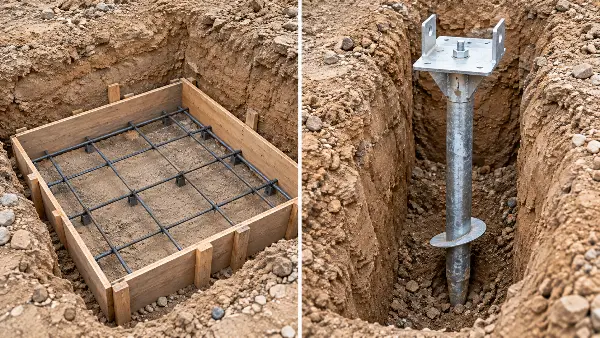
For its footprint, yes. A helical pier carries its load on deeper soil, so it needs far less ground contact at the surface than a footing does.
The American Wood Council’s deck guide sizes footings for soil that bears 1,500 pounds per square foot. That means a concrete footing needs 18.6 square feet of contact, about 4 feet 4 inches on a side, to carry 27,900 pounds. The pier gets the same rating from a 2-7/8 inch shaft and plates no wider than 14 inches.
That’s also why a per-square-foot rating doesn’t fit a pier. Piers are rated in pounds per pier. The per-square-foot number belongs to the soil, and your soils report gives it for your lot.
How many piers a structure needs
Divide the design load by the rating per pier and round up. Then an engineer adjusts for spacing and footing strength, since ESR-3969 calls for calculations and drawings from a registered design professional on every project.
Say an engineer puts 100,000 pounds on 1 wall line of a house. Divided by 27,900 pounds per repair pier, the load alone calls for 3.6 piers, so 4. Pier spacing, the footing’s own strength and the span between piers can raise that count.
Decks and porches
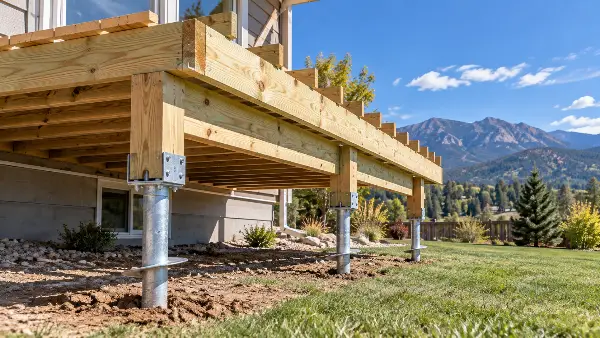
Decks work out differently. The same guide uses 40 pounds per square foot of live load and 10 of dead load, 50 in all. A post holding up 80 square feet of deck carries about 4,000 pounds. The 2-7/8 inch pier’s ratings run 7 to 10 times that, so on a deck like this, beam spans and post spacing set the pier count.
Snow changes the numbers. The guide’s tables cover snow loads up to 40 psf, and only where snow won’t slide or drift onto the deck. Your building department sets the local snow load.
What Changes On Colorado’s Swelling Clay?
Pull-up ratings start to matter. Clay that swells pushes up on foundations, so the pier and its bracket need an uplift rating as well as a weight rating.
Swelling clay is common along the Front Range. The Colorado Geological Survey mapped potentially swelling soil across the Front Range Urban Corridor. That strip runs from Fort Collins and Greeley to Pueblo and Cañon City, and it holds more than 80% of the state’s population. The survey found swelling clay in about half of the 30 sedimentary bedrock formations there.
For pull-up, the report uses a Kt of 8 on this pier. That works out to 35,360 pounds allowable from the soil at the 8,840 foot-pound limit, or 28,288 pounds on a house with no soils report. On the steel side, the direct-load bracket carries a 33,940-pound pull-up rating. The side-load repair bracket has none.
So if heave is part of your problem, ask which bracket goes on and what its pull-up rating is. A bracket without a pull-up rating isn’t rated to hold a footing down. Depth below the swelling layer is a separate check, and your soils report sets it.
Get A Written Load Rating For Your Project
Before you sign for piers, get the ratings in writing: pier count, bracket type, target torque and the allowable load per pier, both push-down and pull-up. How much weight can a helical pier hold on your site? That page answers it in pounds. Call 303-578-4414 to set up a site visit. We install helical piers across Colorado from our base in Elizabeth.
FAQs
How much weight can a helical pier hold on a house?
Under ICC-ES report ESR-3969, a 2-7/8 inch pier under an existing house is capped at 27,900 pounds of allowable load by its side-load bracket. The soil still has to prove that rating through final torque, at 4.5 pounds per foot-pound with a soils report. Larger commercial piles are rated higher.
How much weight can a helical pier hold without a soils report?
Less, under the International Residential Code. Without a site-specific soils report, ESR-3969 divides the torque-based ultimate capacity by 2.5 instead of 2. That lowers the soil rating at the system’s 8,840 foot-pound limit from 39,780 pounds to 31,824 pounds.
What is the load capacity of a helical pile?
It’s the lowest of 4 ratings: the bracket, the shaft, the helix plates and the soil. Its soil rating equals a torque factor times the final installation torque, divided by a safety factor of 2. For a 2-7/8 inch pile under ESR-3969, that torque factor is 9 for push-down loads.
Can helical piers resist uplift from swelling clay?
Yes, with the right bracket. ESR-3969 rates the direct-load bracket at 33,940 pounds of pull-up, and the side-load repair bracket has no pull-up rating. If heave is part of the problem, ask which bracket your plan uses.
Why do some helical pier ratings run into the hundreds of tons?
Those ratings belong to large-diameter commercial piles or to groups of piers working together. A residential 2-7/8 inch pier is rated in the tens of thousands of pounds. Check whether a number is ultimate or allowable before you compare.
Is a helical pier stronger than a concrete footing?
For its footprint, yes. The American Wood Council’s deck guide assumes soil that bears 1,500 pounds per square foot, so a footing needs 18.6 square feet of contact to match a 27,900-pound pier rating. The pier reaches that rating with a 2-7/8 inch shaft because its plates bear on deeper soil.