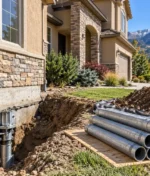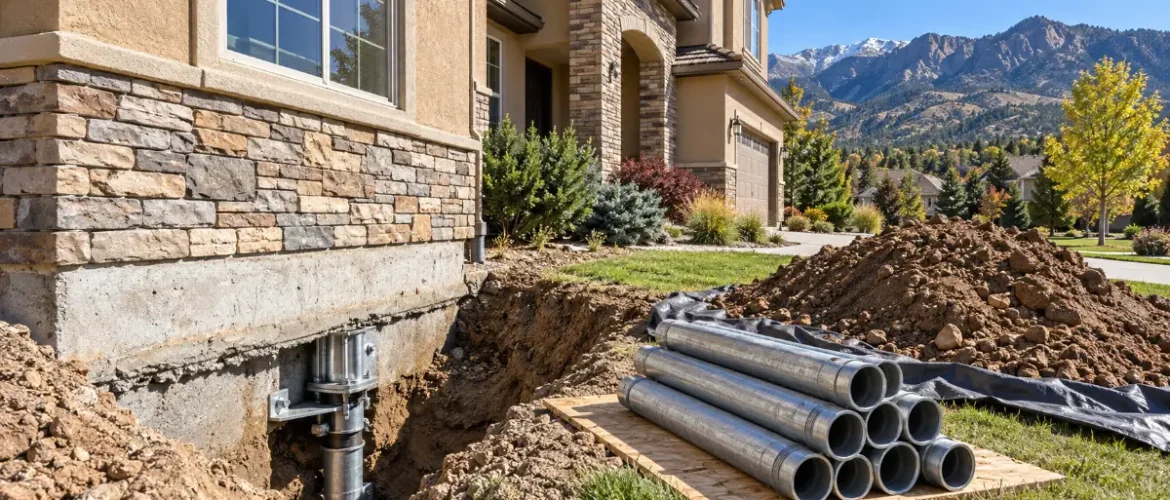
Push piers are steel pipes that a hydraulic ram drives through weak soil until they reach bedrock or firm ground. A bracket then locks them to your footing to stop a sinking foundation and, often, lift it back toward level. They work best on heavy homes where bedrock sits close to the surface.
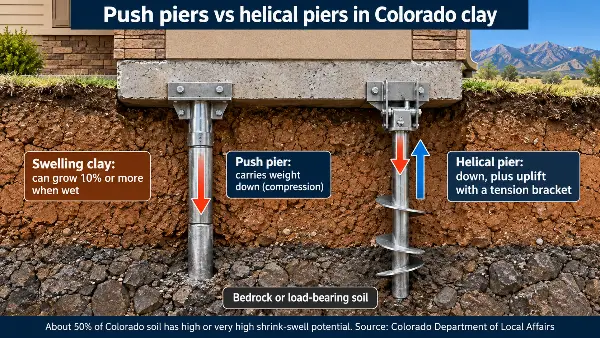
They can’t stop a foundation that’s rising. In Colorado, that gap matters: about 50% of the state’s soil has a high or very high potential to shrink and swell, according to the Colorado Department of Local Affairs.
So before anyone quotes you piers, find out which way your house is moving. Cracked drywall, sticking doors, sloping floors and gaps at trim show up either way, so the signs of foundation movement alone won’t tell you.
What Are Push Piers?
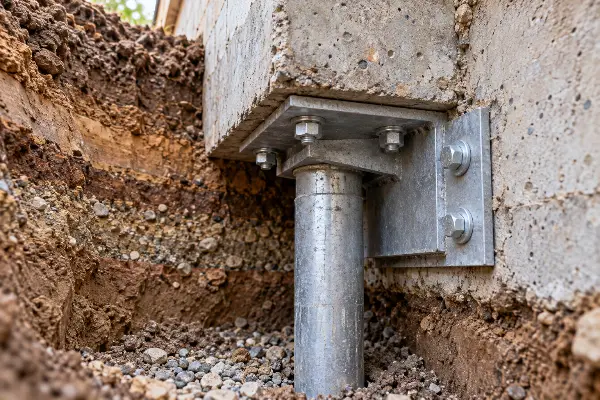
Push piers are steel pipe sections pressed straight down beside a foundation by a hydraulic ram, using the weight of the house as the counterweight, until they reach bedrock or load-bearing soil. A steel bracket under the footing then moves the home’s weight onto the piers, which stops further settling and can lift the house back toward level.
You’ll also hear them called resistance piers, because the house resists the push.
We install a push pier system with 2-7/8 or 3-1/2 inch steel shafts in 18 or 36 inch sections, galvanized or bare depending on the job. Each pier gets the Tru-Lift bracket. The driving gear is light enough to carry by hand, so push piers can go in from a tight side yard, a crawlspace or inside a basement.
How Push Piers Work, And Why Every Pier Gets A Load Test
A push pier uses your house as the anchor for its hydraulic ram, and the pressure it takes to drive the pier shows how much load it can carry. The crew digs down to the footing at each pier spot, bolts a bracket under the footing and sets the ram on the bracket.
The ram presses a steel section into the ground, then the next. Each new section has a coupler that slides into the section below it. Sections keep going in until the pier reaches refusal, meaning bedrock or soil firm enough that the ram can’t push it any deeper.
A gauge on the ram shows the driving force the whole way down. Holding that pressure on the pier at its final depth load tests it, as a licensed engineer explains in a December 2024 Waterproof! Magazine article on push and helical piers. You get a measured number for each pier.
The Catch Is House Weight
Push piers need the house to push against. If the structure is too light, the ram lifts the house before the pier reaches firm soil. The pier then stops in the same weak ground that caused the problem. That’s part of why helical piers, which don’t load your foundation during install, are our default for homes, decks and additions.
Settling Vs Heaving: Why Direction Matters On Colorado Clay
Push piers fix settling. They can’t stop heave, and swelling clay is common in Colorado.
The Department of Local Affairs lists swelling soil among Colorado’s most widespread geologic hazards and notes that clay can grow 10% or more in volume as it gets wet. That swelling pushes up on foundations and slabs. The Colorado Geological Survey’s guide to swelling soils adds that the damage can build slowly and hit houses in the same neighborhood at different times.
Some push pier marketing claims the piers make swelling soil a non-issue. On Colorado clay, that’s wrong, and the product paperwork says so. ICC-ES, the evaluation service that checks building products against the codes, wrote its acceptance criteria AC517 for push pier systems that resist compression, meaning weight pushing down. The evaluation reports we checked under it list compression capacities only. The engineer cited above adds that push piers can’t resist tension, the upward pull that heave puts on a foundation, without field welding or other changes.
Heave inside the house is its own problem. A basement slab that’s cracking and rising in the middle of a room usually isn’t tied to the footing, so piers under the walls won’t touch it.
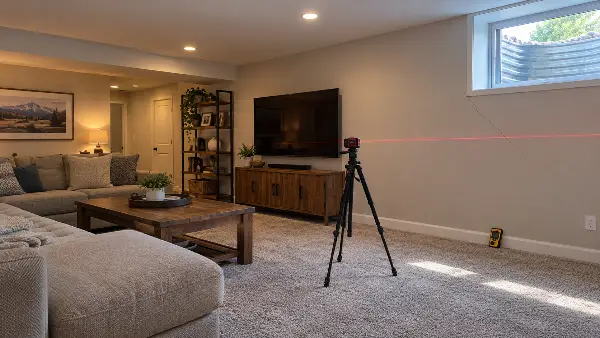
That’s why direction comes first. A good assessment maps the floors with a laser or zip level to find which areas sit high and which sit low. That engineer warns that reading cracks alone can lead to the wrong repair. Our foundation repair work starts with the cause of the movement, not the crack.
Newer Homes Come With A Soils Report
If your house was built new, check your closing papers. Colorado law (C.R.S. 6-6.5-101) requires builders to give buyers of a new home a summary of the soils report and site recommendations at least 14 days before closing. That summary gives an engineer a head start on what’s under your house.
Push Piers Vs Helical Piers: Which Fits A Colorado Home?
For most Colorado homes, decks, porches and additions, helical piers are our usual pick. Push piers earn the job when bedrock sits close to the surface and the structure is heavy, with substantial concrete footings.
| Push piers | Helical piers | |
|---|---|---|
| How they go in | Pressed straight down by a hydraulic ram, using the house as the counterweight | Screwed in by a hydraulic torque motor, separate from the house |
| Need house weight to install | Yes | No |
| Loads they carry | Compression (down) | Compression, plus tension (up) with the right bracket |
| Install angle | Vertical | Vertical or angled |
| Capacity check on site | Hydraulic pressure held at final depth | Torque reading during install |
| New construction | Not without special driving equipment | Yes |
| Best fit in Colorado | Heavy structures with substantial footings over shallow bedrock | Most homes and light structures |
On material alone, the same engineer notes that push piers usually cost less than helical piers when both have to reach the same depth. That edge disappears when the house is too light to drive them. For light structures, helical pier installation makes more sense: the pier goes in without loading your foundation, and the torque reading confirms its capacity on site.
Is Your House Heavy Enough For Push Piers?
If your home has a full basement or footings set below frost depth, it’s usually heavy enough, according to the Waterproof! article. Shallow footings and thickened-edge slabs may need helical piers instead.
Its rule of thumb is blunt: when you’re in doubt about a structure’s weight, go with helical piers.
Weight also has to rest on a sound footing. ICC-ES reports for push pier systems limit the brackets to uncracked concrete, so a split or crumbling footing gets repaired before a bracket goes on, or the plan changes.
Decks, Porches And Additions
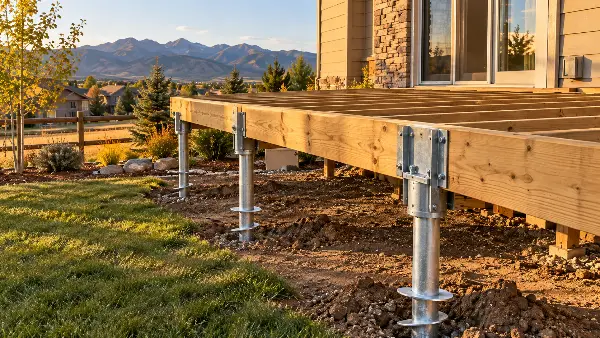
These are usually too light to drive push piers to firm ground. A helical pier doesn’t need that weight, which is why it’s the one we reach for here. If you’re comparing options for a deck or addition, it helps to know how helical piles work before you get quotes.
How Deep Push Piers Go In Colorado Soil
There’s no standard depth. Each push pier goes down until it reaches bedrock or soil firm enough to carry the load in the plan, so the depth of that stable layer sets the number of sections.
That’s why we point push piers at shallow bedrock. PierTech, which makes the Tru-Lift bracket we use, recommends push piers when bedrock or load-bearing soil sits close to the surface. When a pier has to pass through deep layers of soft soil first, PierTech recommends helical piers. The evaluation reports also tell the engineer to set a minimum depth around local hazards such as frost and expansive soil.
What Proves Each Pier Reached Firm Ground?
Ask for the install log, with the final depth and hydraulic pressure recorded for every pier. Pressure held at final depth is the load test, and the depth shows the pier reached the layer it was meant to reach. If a contractor can’t show you both for each pier, you’re taking the work on faith.
What Happens On Install Day?
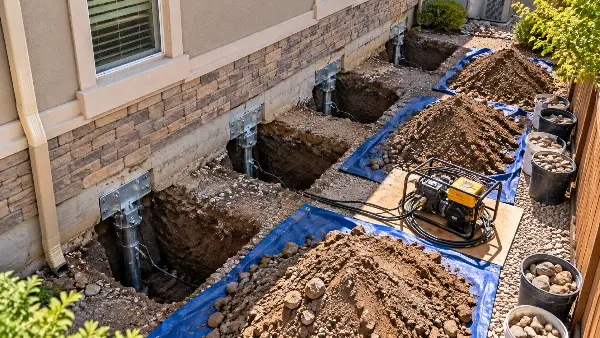
Most push pier jobs follow 5 steps, and the digging is the part you’ll notice most.
- A site assessment sets the number of piers and where they go.
- The crew digs down to the footing at each pier location, outside or inside.
- Brackets go under the footing, and the piers are driven to firm soil.
- The house is raised hydraulically where needed, and the brackets are locked in place.
- The holes are backfilled and the landscaping goes back.
Permit rules vary by city and county, so settle who handles the permit before work starts. ICC-ES reports call for engineering by a registered design professional, plus a soils report when the building official asks for one. We add P.E. stamped drawings when your permit, lender or insurer requires them.
5 Questions To Ask Before You Sign A Push Pier Contract In 2026
Get written answers to these before anyone digs. A contractor who can’t answer them hasn’t diagnosed your house yet.
- Is my house settling or heaving, and can I see the elevation map?
- Will my house’s weight drive push piers to firm soil, or does it need helical piers?
- What depth and hydraulic pressure will you record for each pier, and do I get a copy?
- Which pier system is it, and what’s its ICC-ES evaluation report number?
- Who pulls the permit, and does an engineer stamp the plan?
Push piers are a solid repair for a heavy Colorado home that’s settling over shallow bedrock. For a light structure, or a house sitting on swelling clay, they’re the wrong tool. Colorado Helical Pier installs both push piers and helical piers across Colorado. Call 303-578-4414 to book a foundation assessment and find out which one your house needs.
FAQs
Do push piers work on expansive clay soil?
Push piers can stop settling on clay, but they can’t hold a footing down when the clay swells. ICC-ES evaluation reports rate push pier systems for compression loads, not uplift. Colorado’s Department of Local Affairs says wet clay can expand 10% or more in volume, so confirm the house is sinking before you choose push piers.
Can push piers lift a house back to level?
Often, yes. Once every pier reaches firm soil, the same hydraulic equipment can raise the footing, and the brackets are locked at the new height. How far a house comes back depends on how long it’s been out of level and what the walls and finishes can take.
How long do push piers last?
Soil chemistry decides how long buried steel lasts. An ICC-ES evaluation report for a push pier system builds a 50-year corrosion allowance into its rated capacities. The same report treats soil with resistivity under 1,000 ohm-cm, pH under 5.5 or sulfates over 1,000 ppm as outside its scope, so corrosive sites need an engineer’s review.
How many push piers does a house need?
There’s no standard count. The number depends on how heavy the structure is and how much of the footing is moving, and the load each pier proves at depth can change the plan. A porch that’s dropping needs fewer piers than a house settling along its whole perimeter.
Can push piers go on a cracked footing?
Not until the footing is repaired. The evaluation reports for push pier systems limit the brackets to uncracked concrete, because a broken footing can’t carry the bracket load. A split or crumbling footing gets fixed first, or the repair plan changes.
Do push piers need a permit in Colorado?
Permit rules vary by city and county, so check with your building department before work starts. Evaluation reports for push pier systems call for engineering by a registered design professional, plus a soils report when the building official asks for one. Your contractor should tell you who pulls the permit and whether the plan gets a P.E. stamp.
Are push piers or helical piers better for a Colorado home?
It depends on the structure’s weight, the footing’s condition, the depth to bedrock and which way the house is moving. Push piers fit heavy homes over shallow bedrock that are settling, and each pier is load tested by hydraulic pressure as it goes in. About 50% of Colorado’s soil is rated high or very high for shrink-swell potential. On that ground, helical piers suit most homes and light structures, because they don’t need the house’s weight and can be built to resist uplift.