Commercial & residential helical pier installation—ICC-ES certified for projects of any size.

Colorado Helical Pier: New Construction & Foundation Repair Solutions

Office Hours: 08:00am-6:00pm

Helical Piers Foundation In Colorado

  • Home
  • Helical Piers Foundation In Colorado
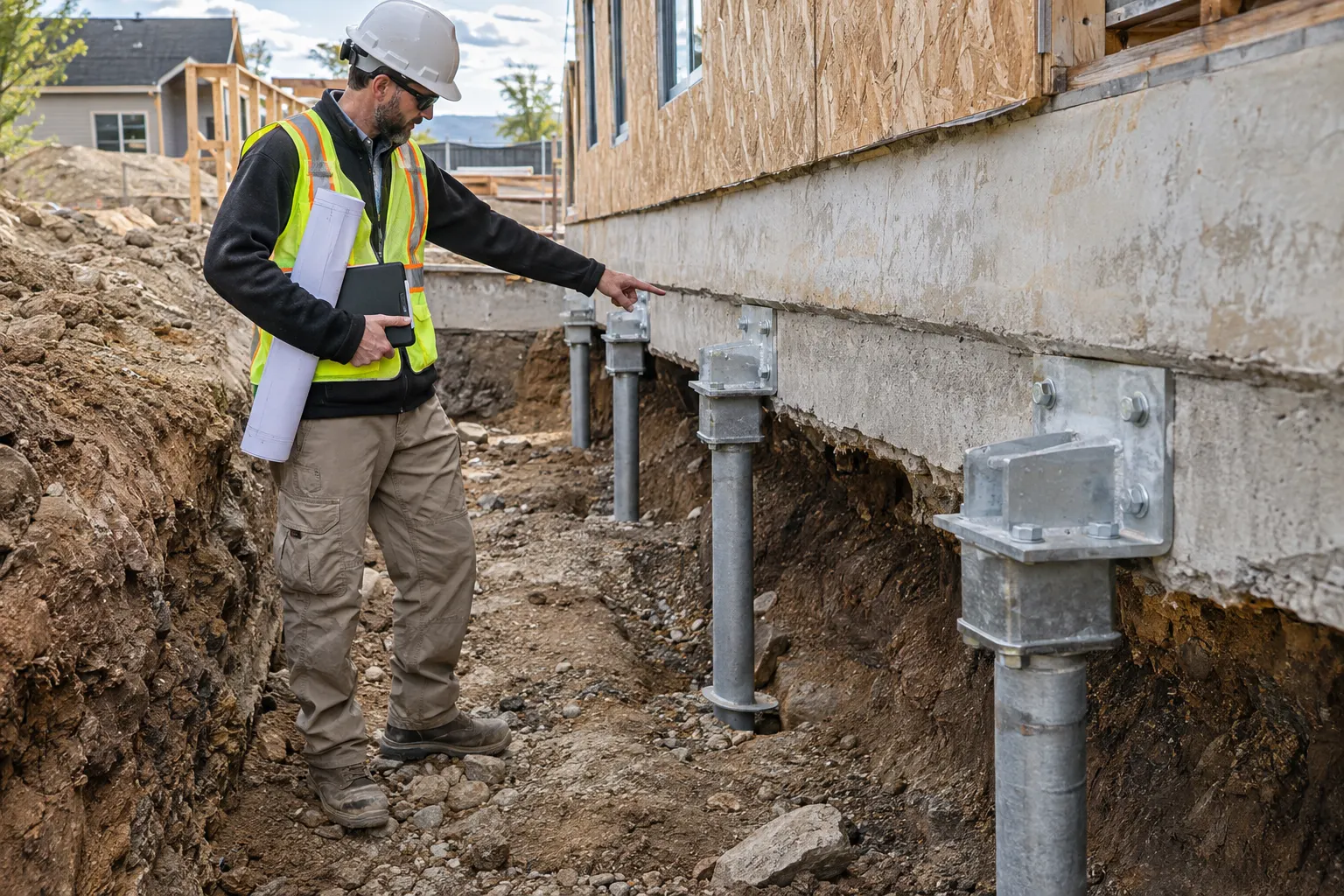
Engineer inspecting helical piers beneath a Colorado home foundation

Helical piers are steel shafts fitted with a helix plate near the tip. A hydraulic drive head screws each one into the ground until the installation torque shows the soil can carry the design load. In expansive clay, the International Building Code requires any foundation that reaches into the clay to be designed against uplift. Colorado Helical Pier handles helical pier installation with PierTech piles, statewide from Elizabeth, in Elbert County.

303-578-4414

Call us for information

Colorado ground changes by region, and so does the pile plan

Any foundation that extends into or through expansive soil has to prevent uplift of the structure, and either resist the swelling forces or be isolated from the clay. That’s Section 1808.6.1 of the International Building Code. For houses, International Residential Code Section R403.1.8 points foundations on expansive soil to IBC Section 1808.6.

The code puts it in 2 lines:

  • “Foundations extending into or penetrating expansive soils shall be designed to prevent uplift of the supported structure.”
  • “Foundations penetrating expansive soils shall be designed to resist forces exerted on the foundation due to soil volume changes or shall be isolated from the expansive soil.”

The first line is the helix’s job. Set in stable soil below the swelling layer, it anchors the pier against the pull of the clay above it, and ESR-3969 lists tension capacity for the PierTech pile alongside compression. The report’s design requirements also call for a minimum pile depth wherever local hazards such as expansive soil set one.

The second line is about the shaft. Swelling clay presses on everything that passes through it, so the design checks uplift as well as bearing. Your building department enforces the code edition it has adopted.

How deep the active zone runs, and where the helix has to finish

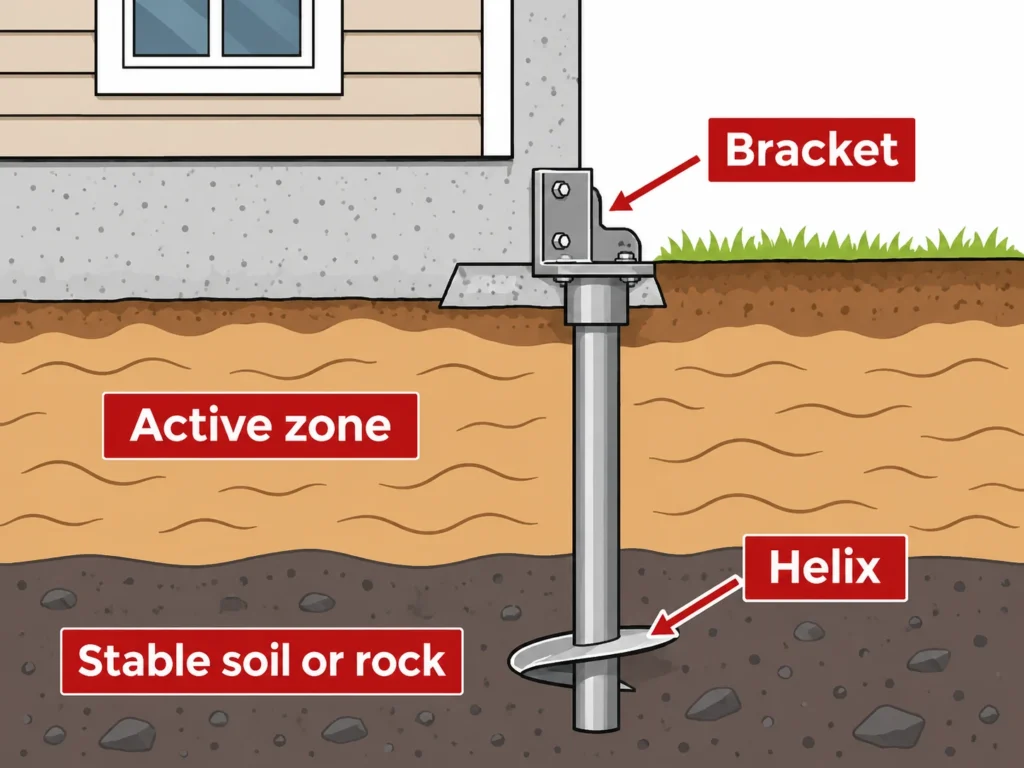
Below the active zone, or on rock if rock comes first. A Colorado State University study notes that Front Range practice assumes an active zone of 15 to 20 feet. Torque decides where each pier stops. Depth is the result.

The active zone is the soil whose moisture changes enough to make it swell and shrink. In Dean Durkee’s 2000 CSU dissertation, seasonal moisture swings reached 5 to 7 feet at a bare test site with no slab. Under a slab, water content rose as deep as 18 feet. A long-term model of an irrigated house projected the active zone reaching 35 feet. Irrigation drives that long-term number, so pier depth has to allow for years of watering.

The Colorado Geological Survey gave the same instruction for piers in 1978: place the bottom “well below the zone of seasonal moisture change” and anchor it “in the non-swelling soil zone to minimize uplift” (Special Publication 11). HomeGuide’s cost guide puts most residential helical pier depths at 10 to 30 feet.

Diagram of a helical pier with its helix set below the expansive clay active zone

4 Design Rules From 20 Years Of Monitoring

John S. Pack’s 2007 Deep Foundations Institute paper on square-shaft helical piers in expansive soils drew on over 20 years of performance monitoring. It sets out these rules:

  • Use only single-helix piers
  • Install to a minimum torque, usually 4,000 ft-lbs, or to refusal
  • Load each pier near its capacity, with longer spans and fewer piers
  • Isolate the structure from the expansive soil with a void zone

Fewer piers, each carrying more of the house, means more weight holding every shaft down against the clay’s upward pull.

The PierTech pile is a 2-7/8-inch round shaft. Its circumference is about 9 inches, against 6 to 7 inches around the 1.5- to 1.75-inch square shafts in Pack’s paper, so each foot of shaft puts more steel surface in the swelling clay. It’s one more reason the helix has to finish below the active zone, where it holds the pier against that grip.

When The Helix Ends On Bedrock

Bedrock can swell too. Along parts of the Front Range the clay-rich layers stand on edge, and the Colorado Geological Survey has published a study of heave in steeply dipping bedrock in Douglas County (Special Publication 42, 1997) and a map of heave-prone areas in the City of Colorado Springs (Map Series 32, 1999).

End bearing on Colorado bedrock is the subject of a 2024 Deep Foundations Institute paper by Melinda Hummel and Howard Perko, “Colorado Geology & End Bearing Helical Piles on Bedrock.” Perko is an adjunct professor at Colorado State University and the author of Helical Piles: A Practical Guide to Design and Installation (Wiley, 2009). If your piers stop on rock, ask the engineer how each pier’s capacity was confirmed. Our engineering support covers load test frame design and load test analysis.

Eco-Friendly and Efficient Helical Pier Products

High-Quality Helical Pier Products

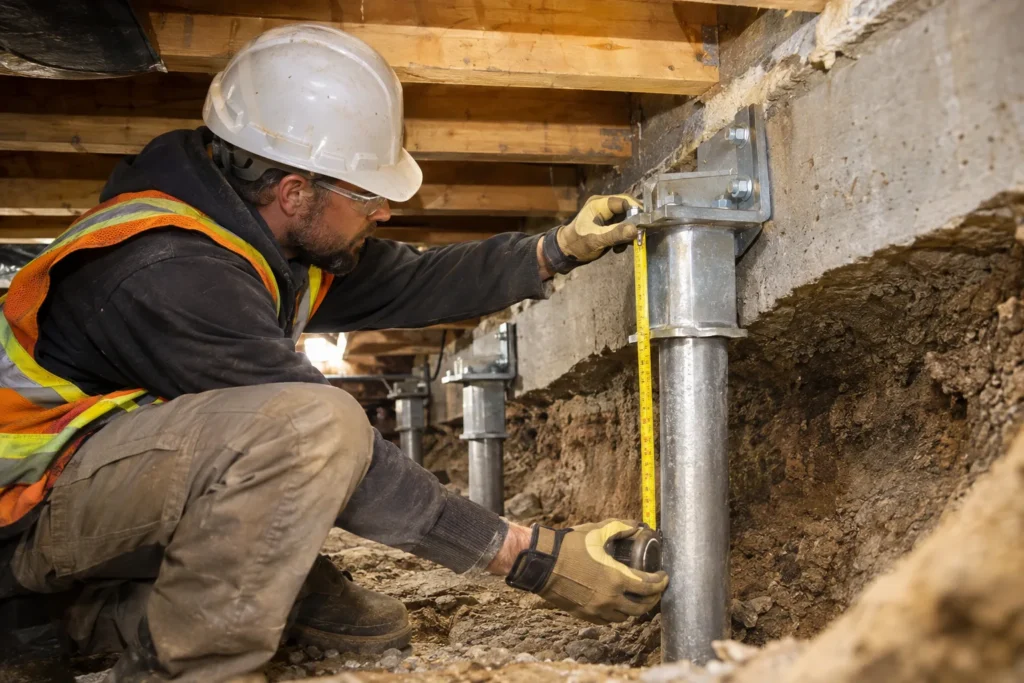
Contractor measuring a helical pier beneath a Colorado home

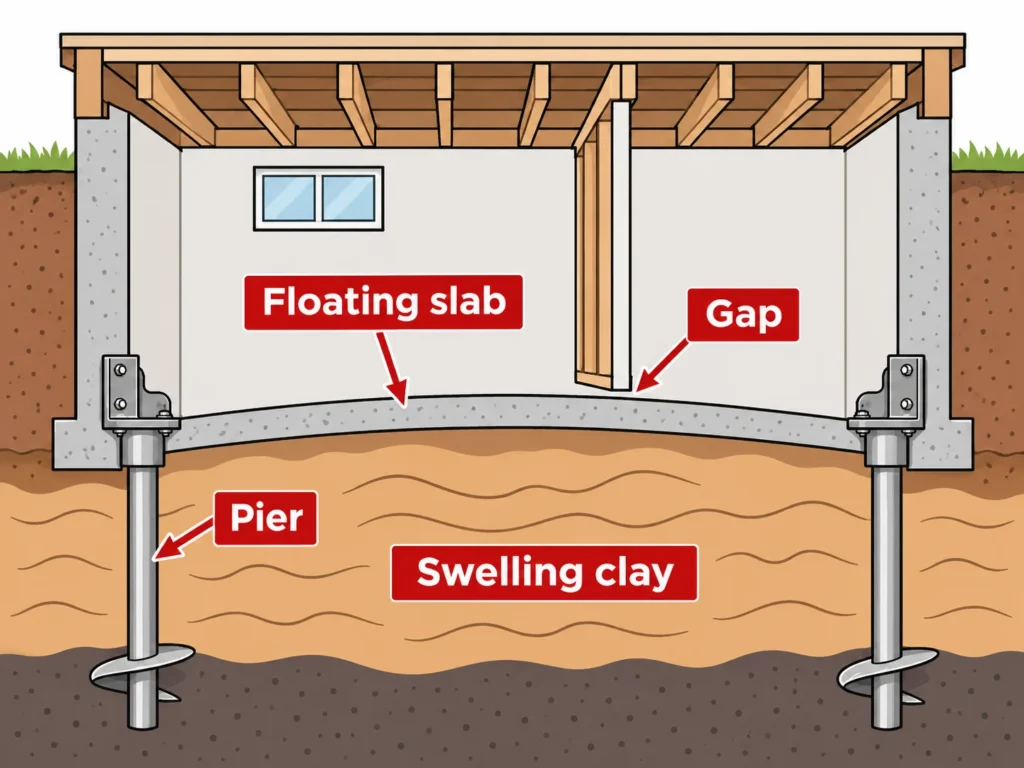
What a helical pier can’t fix: the floating slab

A helical pier holds up the walls it’s attached to. It does nothing for a floating basement slab, which rests on the soil and is built to move on its own.

The Colorado Geological Survey describes the floating slab for “basement, garage, and other floors resting on the soil,” with nonbearing walls “suspended from the ceiling” and a gap above the floor so the slab can rise without lifting them (Special Publication 11). Pier the foundation walls and the clay under that slab can still swell. A basement finished with partition walls built tight to the floor can keep cracking after the piers go in.

Slab heave is a water problem. The same CGS publication reads like a checklist:

  • Grade the ground to fall 12 inches over the first 10 feet from the house
  • Carry roof runoff at least 10 feet from the building
  • Keep grass, shrubs, flowers, and sprinkler lines at least 5 feet from the foundation
  • Don’t let water stand near the foundation

At the assessment we’ll point out the drainage items on your lot. If you’re still sorting out what’s moving, start with the warning signs of foundation movement. For the push-pier side of the heave question, read what push piers fix and what they can’t.

Selling later: what Colorado’s disclosure form asks

Colorado’s residential Seller’s Property Disclosure asks about the exact things a pier job touches. The current version, form SPD19, became mandatory for brokers on January 1, 2026. It asks about:

  • Structural supports or reinforcements added (item A.2)
  • Settling, movement, cracking, or heaving of foundations (A.6.a)
  • Expansive soils on the property (N.7)
  • Non-aesthetic alterations made without a building permit (L.9)
  • Written soils or engineering reports (R.1)

Keep 1 folder: the permit and final inspection if your jurisdiction required them, the engineer’s letter or stamped drawings, the final torque reading for each pier, and the drainage receipts. The folder gives a buyer’s inspector something to check.

Will homeowners insurance pay for the repair?

Usually not when soil movement is the cause. Homeowners policies generally carry an earth movement exclusion. A Nationwide policy quoted by the federal appeals court for Colorado in 2021 excludes “any other earth movement including earth sinking, rising or shifting.” Read the exclusions in your own policy, and ask your agent in writing before you plan around a claim.

Floating basement slab heaving over swelling clay while helical piers hold the walls

Want to Get Helical Piles Services?

Testimonials

Check what Our clients say!

At Colorado Helical Pier, we take pride in delivering exceptional services to our clients. Don’t just take our word for it—read what our happy customers have to say about their experience with us!

597

customers have given rating for support

Average rating 5 / 5

Expert Foundation Solutions

Get A Written Pier Plan For Your Property

Tell us what’s moving or what you’re building. We’ll set up an on-site assessment, then put the plan in writing: the number of piers, where each one goes, the target depth, and the capacity. No obligation.

Cart

No products in the cart.