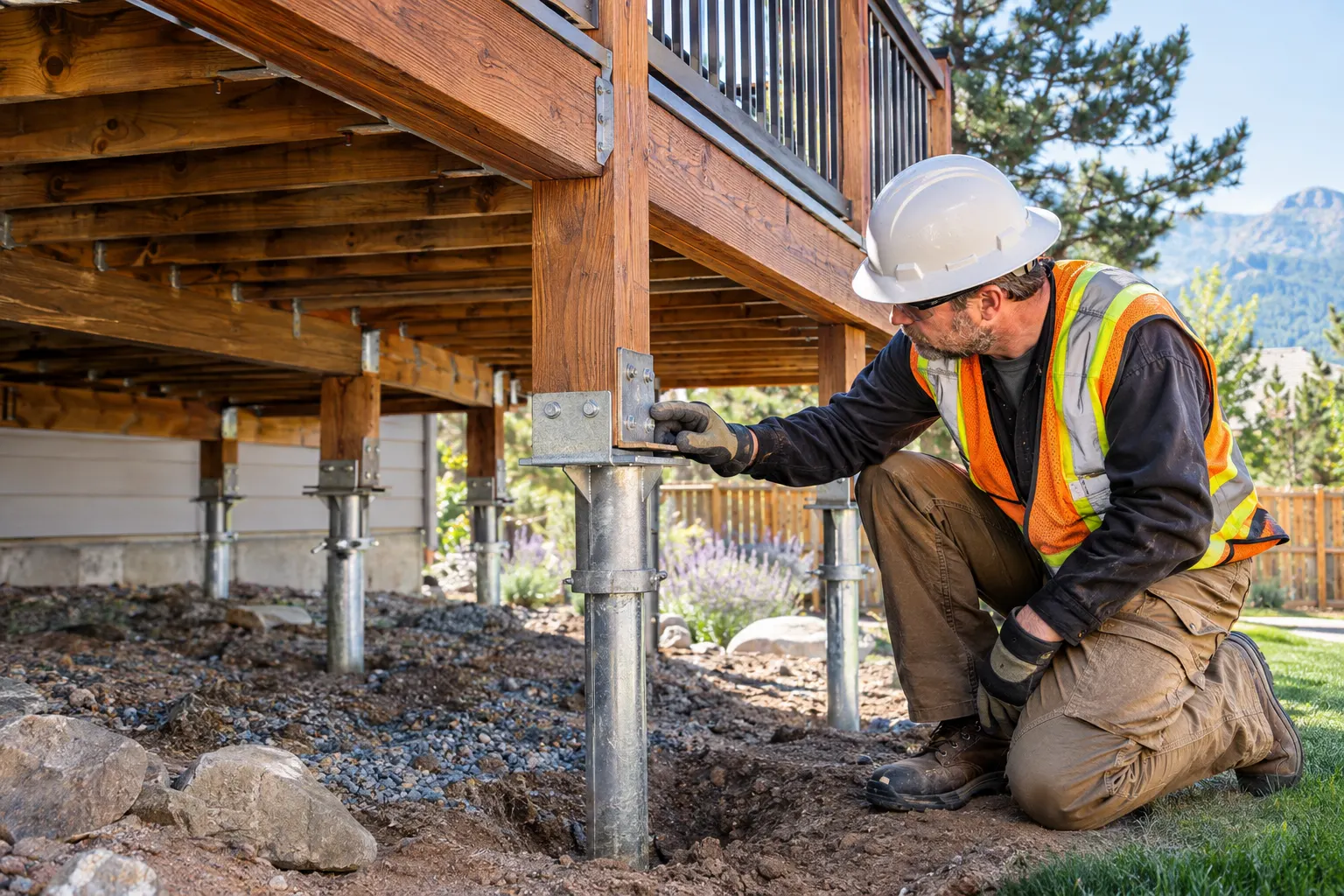
Colorado Helical Pier sets PierTech helical piers under decks anywhere in Colorado. Each pier is screwed down one section at a time until it passes the depth your engineer sets for the site and installation torque confirms it can carry its post. On site, most residential jobs take 1 to 4 days, and your deck builder can frame as soon as the last pier is set.
303-578-4414
Call us for information
How helical deck piers work in Colorado
A helical deck pier is a steel shaft with 1 or more helix plates near its tip. A machine-mounted drive turns it into the ground under each deck post, and a bracket on top carries the post. Builders also call them screw piles or helical deck footings.
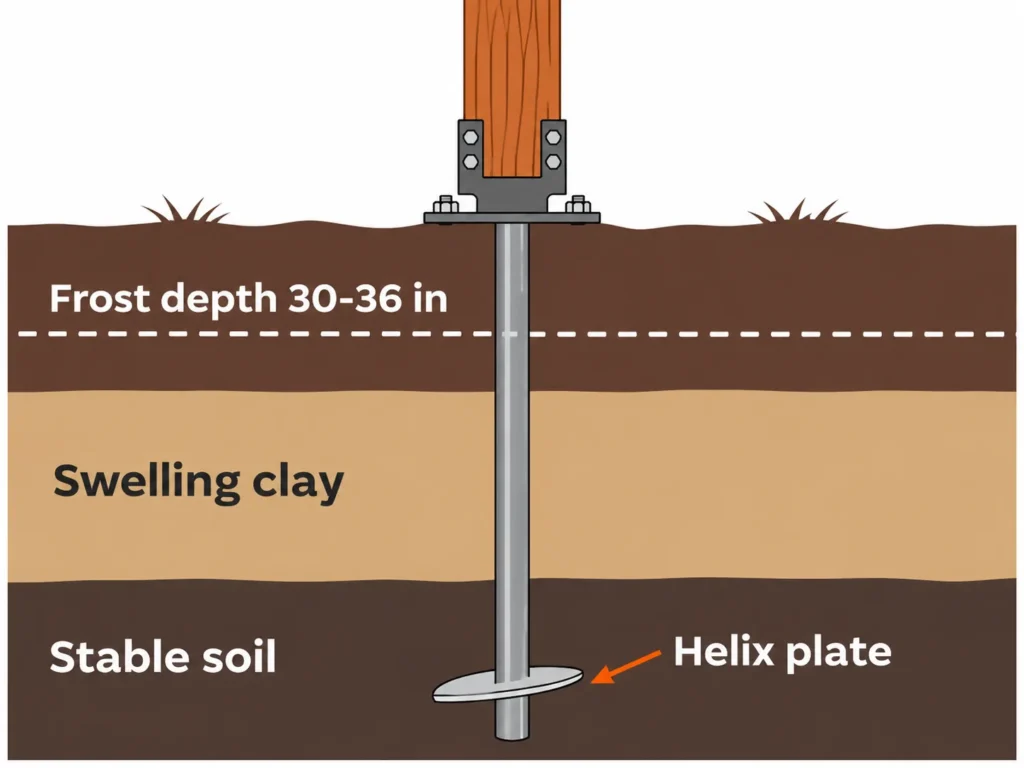
In Colorado a deck pier has 2 depths to clear. The first is the frost depth your building department enforces: 30 or 36 inches along the Front Range. The second is the minimum depth your engineer sets from the site’s soil, and on swelling clay that can sit well below the frost line. Torque at the end of the install then confirms the pier can carry its share of the deck.
Colorado Helical Pier works out of Elizabeth and books residential jobs by region: the Denver metro, Colorado Springs, Fort Collins and Loveland, Boulder and Longmont, Castle Rock and Parker, Pueblo, Greeley, Grand Junction, Glenwood Springs and Durango.
Deck footing frost depth by Colorado jurisdiction
Along the Front Range, building departments set deck footing frost depth at 30 or 36 inches, and each one decides how it treats helical piers. These are the published values as of October 2026. Departments revise their handouts between code cycles, so confirm yours when you apply for the permit.
- Denver: 36 inches, set in the city’s amended residential code (Section R403.1.4.1).
- Douglas County: 36 inches. The county’s 2021 code amendments set a 36-inch minimum frost depth for all areas of the county.
- Fort Collins: 30 inches for decks attached to the house and 12 inches for freestanding decks. The city’s Residential Deck Guide, revised June 24, 2026 under the 2024 IRC, lists “specialty piers (helical etc.)” among the conditions that require engineered, stamped plans or letters.
- Larimer County: 30 inches. If rock turns up within 30 inches, the county’s deck handout allows a 12-inch #4 rebar dowel set 6 inches into the rock and epoxied, or an engineered detail.
- Boulder County: 30 inches. The county requires a design stamped by a Colorado-licensed engineer or architect where ground snow load exceeds 70 psf or design wind speed reaches 140 mph, and says most of unincorporated Boulder County will need that stamp.
- Colorado Springs and El Paso County: 30 inches under the Pikes Peak Regional Building Code.
- Jefferson County: the county’s deck guide, revised July 23, 2025, sets permits by deck height. No permit at 12 inches or less above grade, a miscellaneous permit above 12 and under 30 inches, and a building permit at 30 inches or more. The guide doesn’t list a frost depth, so ask the county.
Make A 3-Question Permit Call
Call the building department before you order lumber. Each answer adds a line to your quote or takes one off.
- What frost depth do you enforce for an attached deck?
- Do helical piles need continuous special inspection on a residential permit?
- Will you accept the manufacturer’s ICC-ES report and a torque log, or do you need a Colorado P.E. stamp and a soils report?
What A Special Inspector Checks
Where a department applies IBC Section 1705.9 to helical piles, an inspector watches every pier go in. PierTech’s ICC-ES report lists 11 items for that inspection. On a deck job the inspector records the installation equipment, tip elevations, installation torque and final depth, and checks each pier’s inclination and location and that every bracket cap plate sits in full contact with its pile. Book the inspector before install day. Continuous inspection means no pier goes in without one on site.
High-Quality Helical Pier Products
Helical Piers & Helical Piles
Helical piers, also known as anchors, piles, or screw piles, provide deep foundation solutions to secure new or repair existing foundations. Thanks to their innovative design and easy installation process, they are ideal for projects where traditional foundation...
Hercules Piles
The patented Hercules Pile by PierTech Systems is a groundbreaking large-diameter pipe pile designed to deliver unmatched stability and capacity. Unlike traditional helical piles, which were primarily suited for residential and light commercial projects...
Push Piers
At Colorado Helical Piers, we offer Push Piers, a trusted foundation solution for stabilizing buildings and structures built on unstable soils. Push Piers are hydraulically-driven pipe sections designed to penetrate weak soil layers and reach...
Tru-Lift Bracket
At Colorado Helical Piers, we are proud to offer the Tru-Lift Bracket, a cutting-edge solution for foundation repair. Unlike traditional brackets, the Tru-Lift Bracket is designed to be lightweight, easy to install, and free from movement once in place...
Cross Lock Connection
Round shaft helical piers are the perfect choice for providing stability in compression applications. One of the common challenges during installation is connecting the helical pile components safely and efficiently. As torque increases, the bolt holes can deform...
How deep a deck pier goes, and what sets the depth
Your engineer sets a minimum tip depth from the soil, and the crew keeps adding extension sections until the pier is past it and torque reaches its design value. The frost line is only the floor.
PierTech’s ICC-ES report expects the soils information to drive that number. It lists a “minimum helical pile depth, if any, based on local geologic hazards such as frost, expansive soils” among the items the geotechnical report gives the designer (ESR-3969, Section 4.1.1). Nationally, HomeGuide puts typical residential helical pier depth at 10 to 30 feet.
Swelling soil is common here. The State of Colorado’s Planning for Hazards guide reports that about 50 percent of Colorado’s soil has a high or very high potential to shrink and swell. A pier tip left inside that layer rises and drops as the soil wets and dries, even when the torque reading looked fine on install day. Torque measures how hard the soil resists the helix as it turns. It can’t tell you what that soil does next spring.
Uplift sets a depth too. When a pier is rated in tension, ESR-3969 requires the helix to sit at least 12 helix diameters below grade (Section 5.18). That works out to 10 feet for a 10-inch plate and 14 feet for a 14-inch plate.
Shaft size matters on swelling soil as well. The Colorado Geological Survey lists improper drilled-pier depth or diameter among the causes of damage on expansive soil. Fort Collins’ deck guide sizes a concrete pier at 19 inches across for a post carrying 60 square feet of deck. That pier has about 716 square inches of side surface per foot of depth. A 2-7/8-inch steel shaft has about 108, roughly 15 percent as much surface for swelling soil to grip.
What the torque reading proves on a deck pier
Torque proves load capacity. On most decks, capacity comes easily and depth is the harder target.
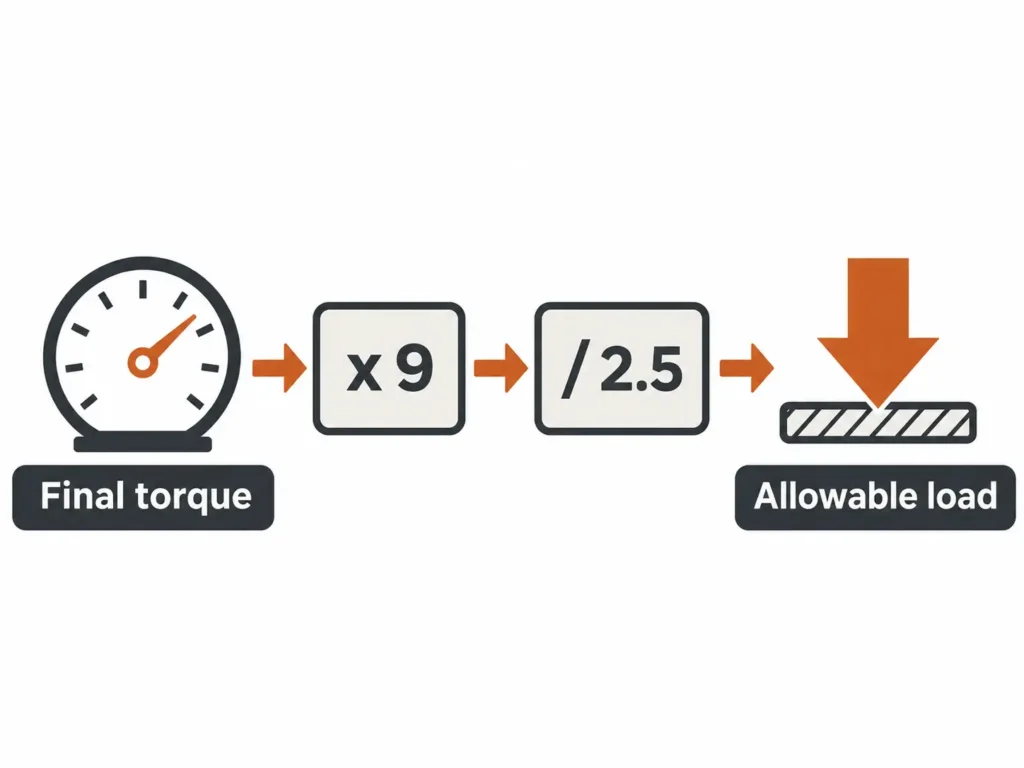
ESR-3969 ties capacity to final installation torque. For PierTech’s 2-7/8-inch shaft, ultimate compression capacity equals 9 times the final torque in foot-pounds. On an IRC project without a site-specific soils report, the report applies a 2.5 safety factor, so each foot-pound of final torque is worth 3.6 pounds of allowable load. The report also requires a registered design professional to design the pier system on IRC work.
Take the 60-square-foot post from Fort Collins’ pier chart. At 50 psf, the 40 psf live load plus 10 psf dead load in Pikes Peak Regional’s deck provisions, that post carries 3,000 pounds. Under the IRC formula, a 2-7/8-inch PierTech pier reaches 3,000 pounds of allowable load at about 830 foot-pounds of final torque. The report allows installation torque up to 8,840 foot-pounds.
Mountain snow raises those loads. Larimer County’s deck handout uses a 70 psf ground snow load between 6,001 and 8,000 feet of elevation, against 45 psf below 6,000 feet, and your engineer runs the numbers for your site.
So hitting the torque target is rarely the hard part. A pier can pass 830 foot-pounds inside swelling soil and still heave with it. That’s why your written pier plan lists a depth and a capacity for each pier, and why the torque log should show both.
How a helical deck pier job runs
The job runs in 5 steps.
- Call with the basics. Deck size, attached or freestanding, the address, and plans or a soils report if you have them.
- Site visit. The crew checks access and reads any soils or engineering reports, then tells you whether helical piers suit the deck.
- Written pier plan. Pier count, placement, depth and capacity for each post, plus stamped drawings if your department needs them for the permit.
- Permit and inspection. The permit sets your frost depth and any special inspection. Book the inspector for install day if one is required.
- Pier day, then framing. Each pier goes in until it passes its design depth and torque, frozen ground included. Your builder can start framing without waiting on concrete.
If the house needs work too, see our residential foundation services.
Want to Get Helical Piles Services?
Check what Our clients say!
At Colorado Helical Pier, we take pride in delivering exceptional services to our clients. Don’t just take our word for it—read what our happy customers have to say about their experience with us!
When a deck has already moved
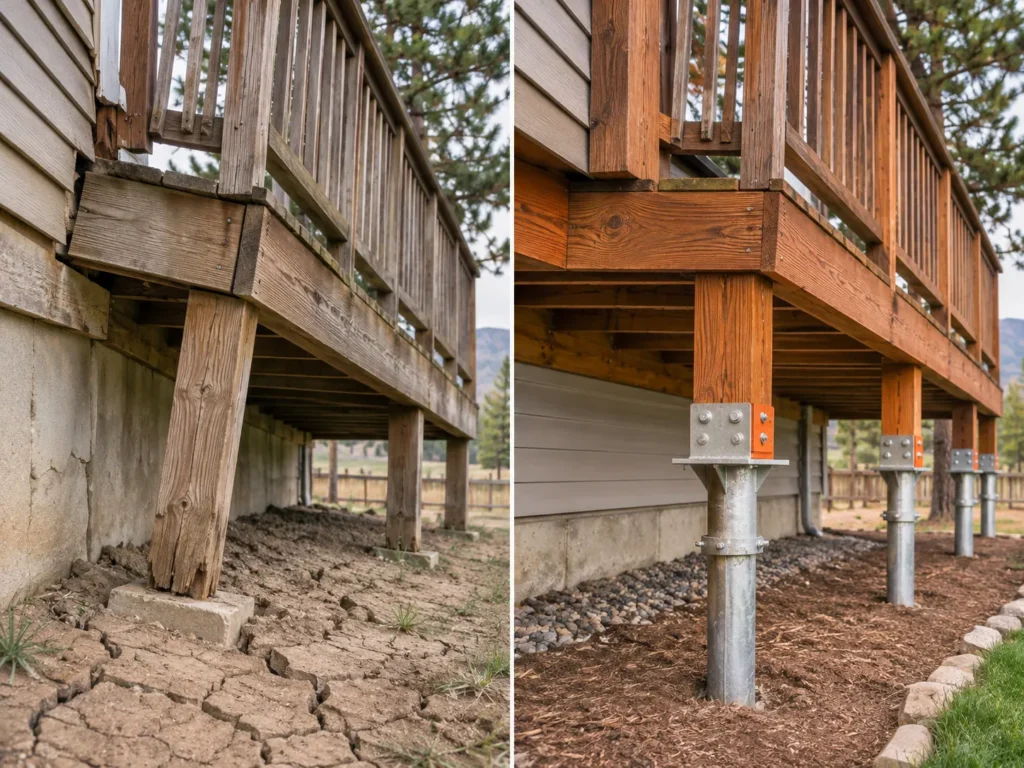
If a deck post has lifted or dropped, the repair needs a pier that bears below the soil that moved, plus a connection that moves the post load onto it. Colorado Helical Pier also repairs sinking decks, porches and additions. The piers are the same system it installs under houses.
Look for a post out of plumb, a beam that has lost its level, stairs pulling away from the landing, or a gap opening where the deck meets the house. A replacement pier that stops in the same soil can move the same way, so the repair depth comes from the soils data too. Have the ledger connection checked on the same visit.
If the house is moving too, start with foundation repair.
When to skip helical piers on a deck
Helical piers aren’t the right call for every deck. HomeGuide notes that standard concrete footings cost less up front, though they take more excavation. Skip helicals when:
- The deck is freestanding and low, and your code allows a shallow footing. Fort Collins requires 12 inches for freestanding decks. A deck like that can shift with the seasons without pulling on the house.
- The site is sand or gravel with no swelling clay, where a concrete footing below frost depth bears well.
- Rock sits within the frost depth. Helix plates need soil to advance through, and Larimer County’s handout allows a footing doweled into rock found within 30 inches.
- The house is what’s moving. Piering the deck alone won’t stop a heaving foundation from pulling on the ledger.
You’ll hear at the site visit whether piers make sense for your deck. The longer comparison with concrete sits in our post on helical piles vs. traditional foundations.
The pier system and the engineers behind it
We install PierTech helical systems. The 2-7/8-inch round shaft has a 0.217-inch wall, takes 8-, 10-, 12- or 14-inch helix plates, and is rated for installation torque up to 8,840 foot-pounds under ICC-ES report ESR-3969, reissued January 2026. The report’s IRC section names exterior porch decks among the light-frame uses it covers.
ESR-3969 also sets corrosion limits. Sites with soil resistivity below 1,000 ohm-cm, pH below 5.5 or sulfates above 1,000 ppm fall outside its scope and need a corrosion analysis first, which our engineering team runs.
Pier designs come from that team, which includes Principal Engineer Bret Anderson and his 40-plus years in geotechnical and structural engineering. When a building department, lender or insurer asks, the team supplies P.E.-stamped drawings. The same system goes under homes, additions and light commercial buildings in our helical pier installation work.
Frequently Asked Questions
How deep do helical deck piers go in Colorado?
Past 2 depths: your department’s frost depth, 30 or 36 inches on the Front Range, and the minimum depth your engineer sets from the soil, which is usually the deeper one. HomeGuide puts typical residential helical pier depth at 10 to 30 feet nationally. Torque confirms capacity once the pier is past the design depth.
How many helical piers does a deck need?
One per post on a new deck. HomeGuide notes that a small deck may need only 3. Fort Collins’ deck guide sizes each footing by the deck area its post carries, from 5 to 160 square feet in its chart, and your engineer sizes each pier for that same load.
Do I need a permit for helical deck piers?
For an attached deck, plan on one. Fort Collins requires a permit for any deck attached to the house, any deck over 200 square feet and any deck more than 30 inches above grade. Jefferson County requires a building permit at 30 inches and up. Your department also decides whether it wants a P.E. stamp, a soils report or special inspection.
Do I need a soils report for deck piers?
Not always. ESR-3969 lets an engineer design IRC deck piers without a site-specific soils report by applying a 2.5 safety factor to the torque-based capacity. Some departments and engineers still want one on clay. If you bought your home new, check your closing papers. Colorado law (C.R.S. 6-6.5-101) requires builders to give buyers a summary of the soils report at least 14 days before closing. Give that summary to your engineer.
Will helical piers stop my deck from heaving?
When the helix bears below the soil that swells, the pier stops moving with it. If the helix stops inside that layer, the pier can heave even after a good torque reading. Depth comes from the soils data, and torque confirms capacity at that depth.
Does a freestanding deck need helical piers?
Not always. Fort Collins requires 12 inches of footing depth for a freestanding deck, against 30 inches for an attached one. A freestanding deck on shallow footings can move with the seasons without pulling on the house. Helical piers make sense when you want that deck to hold its level.
Get A Pier Plan For Your Deck
Send the deck size and address. We’ll look at the site and confirm what your building department wants, then send the pier layout in writing, with depth and capacity for each post.