Commercial & residential helical pier installation—ICC-ES certified for projects of any size.

Colorado Helical Pier: New Construction & Foundation Repair Solutions

Office Hours: 08:00am-6:00pm

Helical Piles Foundation In Colorado

  • Home
  • Helical Piles Foundation In Colorado
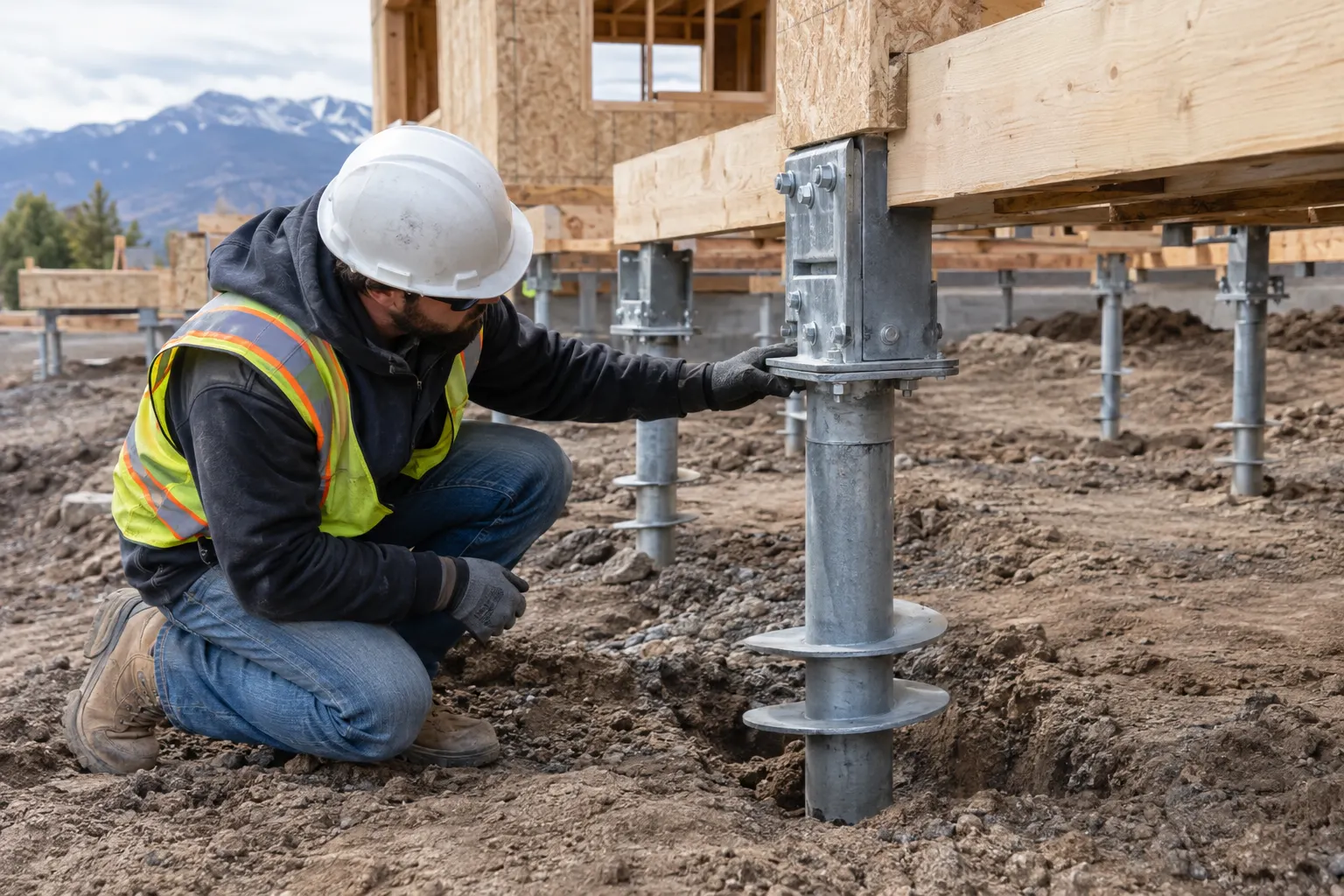
Worker inspecting helical piles for a Colorado home foundation

Helical piles for homes, additions, decks and commercial buildings on Colorado’s swelling clay and shallow rock. Every pile is torqued to prove its load. Pile count, placement, depth and rated capacity come in writing before work starts.

303-578-4414

Call us for information

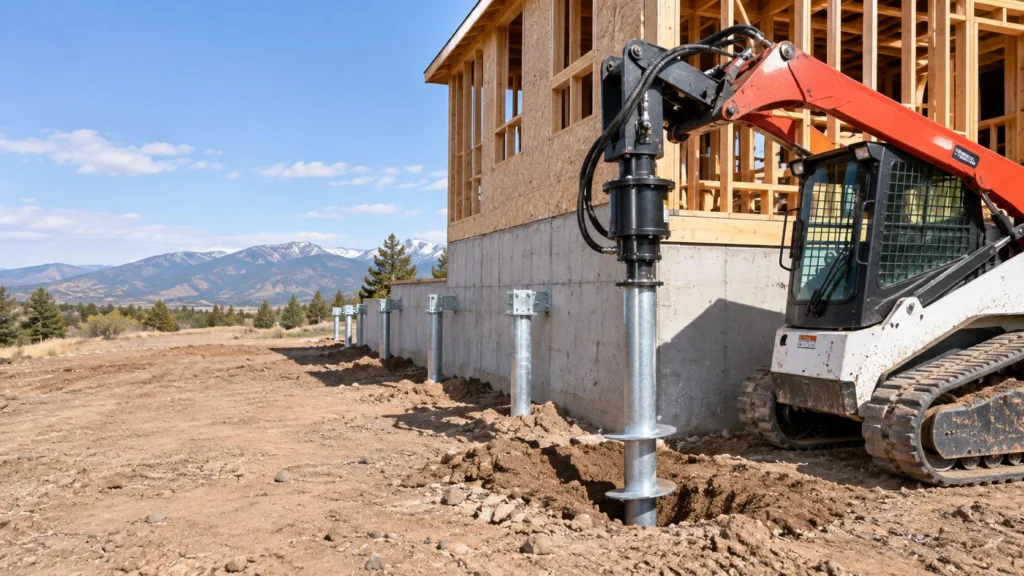
Helical pile being installed beside a new home foundation on Colorado clay soil

What a helical pile foundation does on Colorado ground

A helical pile foundation carries a building on steel shafts fitted with screw-shaped plates, called helices, that a hydraulic drive turns into the ground. Torque climbs as the helices bite into firmer soil, and that reading converts to load capacity. If you want the parts first, see how a helical pile is built.

On Colorado clay, the target is depth. The helices need to sit below the soil that swells and shrinks with moisture, a layer Front Range practice has assumed runs 15 to 20 feet deep.

Colorado Helical Pier installs PierTech 2-7/8-inch helical piles listed in ICC-ES evaluation report ESR-3969, on foundation repairs, new homes, additions and commercial projects across the state. Most residential installs take 1 to 4 days. Pricing follows an on-site assessment.

Why shallow footings move on Colorado clay

The Colorado Geological Survey calls expansive soil “Colorado’s most significant geologic hazard” and says these clays “cause more property damage than any other natural hazard” (CGS, Expansive Soil and Rock). Wet clay swells. Dry clay shrinks. A footing poured inside that layer rides every cycle, and the walls above it take the damage.

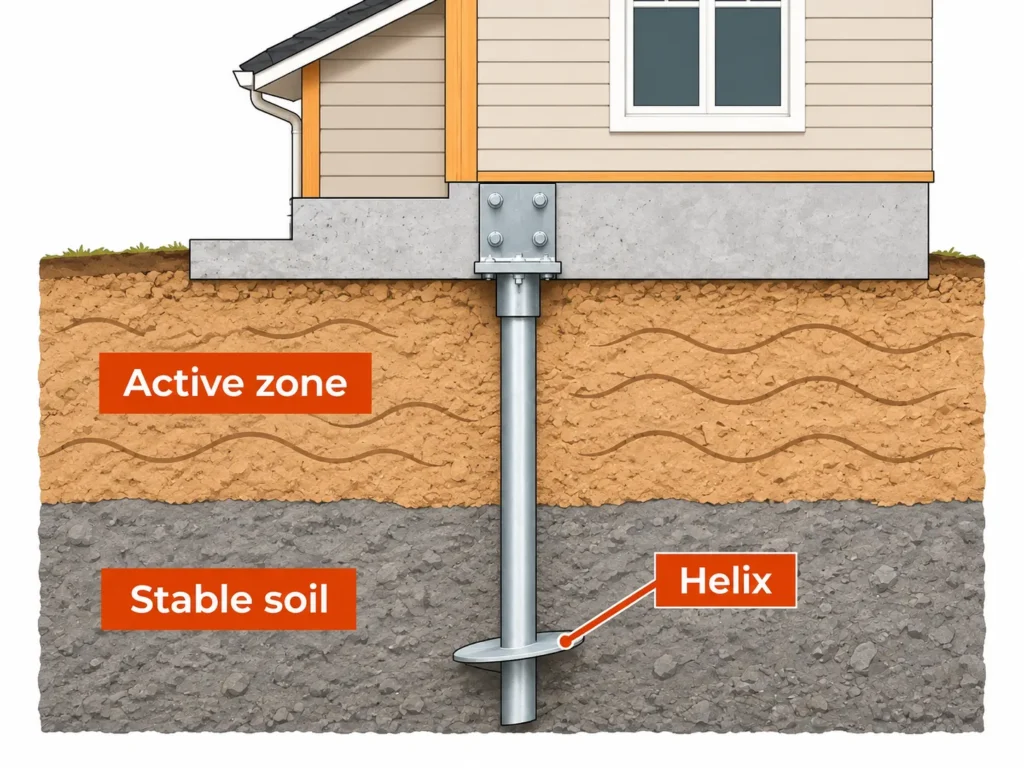
The number that decides your foundation is how deep that moving layer goes. Engineers call it the active zone. A 2000 Colorado State University dissertation on active zone depth notes that Front Range practice has assumed it at 15 to 20 feet. The same study reports moisture increases as deep as 18 feet beneath a slab, and it modeled a long-term active zone of 35 feet at a test site irrigated to Northern Colorado Water Conservancy District guidelines.

Your soils report and the torque log set the depth on your lot. A chart can’t.

A concrete footing at frost depth on swelling clay still sits inside the active zone. A helical pile carries the load below it.

Frost depth by county, and why it rarely sets pile depth

Frost depth is the minimum depth a footing has to reach so freezing ground can’t lift it. Colorado has no statewide figure. Each building department publishes its own:

  • Elbert County: 36 inches
  • Douglas County: 36 inches
  • Jefferson County: 36 inches
  • Boulder County: 30 inches
  • Larimer County: 30 inches
  • Pikes Peak Regional Building Department (Colorado Springs and El Paso County): 30 inches
  • Gunnison County: 36 inches
  • Summit County: 40 inches
  • Eagle County: 48 inches, or as the geotechnical engineer’s report specifies

Mountain counties don’t all run deeper, as Gunnison shows. Denver sets its figure in local amendments to its building code, so confirm the current number with the city. Code cycles change these numbers everywhere, and your building department has the final word before design.

On swelling clay, frost depth is the shallow requirement. A helical pile passes it early, and the active zone and the final torque decide where the pile stops.

Eco-Friendly and Efficient Helical Pier Products

High-Quality Helical Pier Products

How torque proves capacity on the pile we install

The International Building Code accepts well-documented correlations with installation torque as one way to establish a helical pile’s capacity (IBC Section 1810.3.3.1.9). The correlation for a specific pile is published in its ICC-ES evaluation report. For the PierTech 2-7/8-inch pile, that’s ICC-ES ESR-3969, reissued January 2026.

ESR-3969 assigns this pile a torque correlation factor, Kt, of 9 in compression and 8 in tension. The math takes 2 lines:

  • Ultimate capacity = final installation torque x Kt
  • Allowable load = ultimate capacity divided by the factor of safety
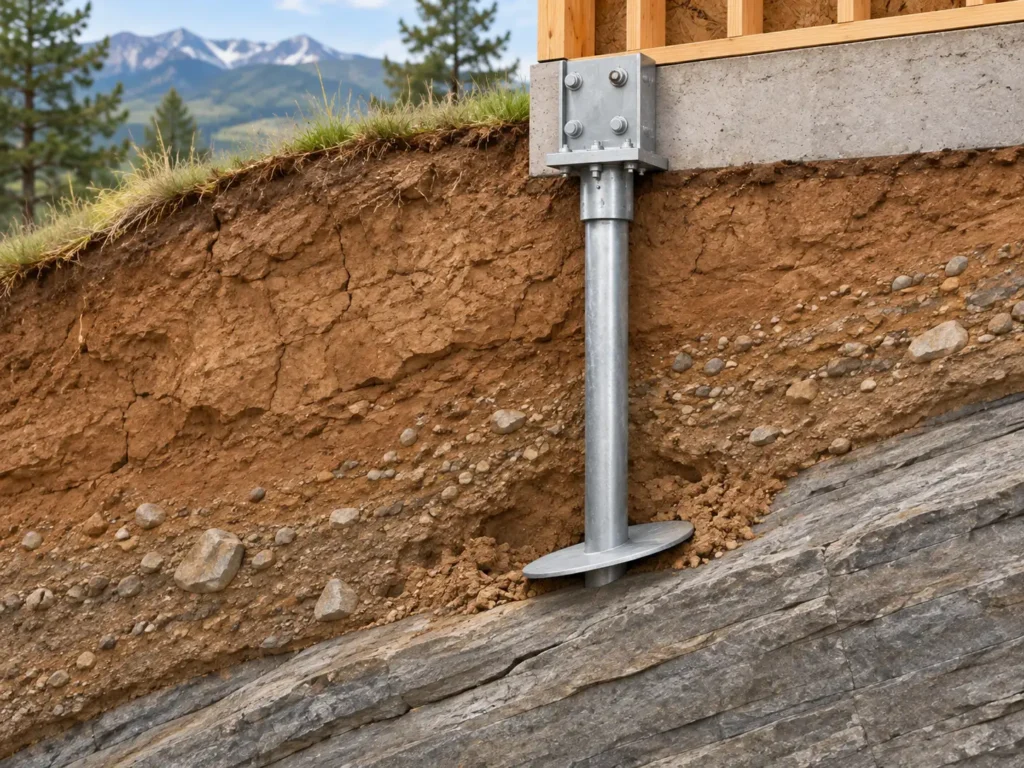
Illustration of a helical pile lead resting on sloping bedrock under Colorado soil

A worked example. A 2007 Deep Foundations Institute paper on square-shaft helical piers in expansive soils lists 4,000 ft-lbs, or refusal, as a typical minimum installation torque. Run 4,000 ft-lbs through ESR-3969:

  • 4,000 x 9 = 36,000 lbs of ultimate capacity in compression
  • Under the International Building Code, divide by 2: 18,000 lbs allowable
  • Under the International Residential Code, when no site-specific geotechnical report exists, ESR-3969 requires a factor of safety of 2.5: 14,400 lbs allowable

The pile has a ceiling too. ESR-3969 rates it to a maximum installation torque of 8,840 ft-lbs, which works out to about 79,600 lbs ultimate and 39,800 lbs allowable in compression.

Then the bracket. On repairs, the Tru-Lift side-load bracket carries an allowable rating of 27,900 lbs, in compression only. Past about 6,200 ft-lbs, extra torque adds soil capacity the bracket can’t pass to the house (IBC basis). The direct-load bracket for new construction is rated at 43,530 lbs in compression and 33,940 lbs in tension.

Torque settles the soil side of the equation. Your engineer of record still checks the shaft, helix plates, couplings and bracket against the same report.

Diagram of a helical pile with its helix below the active zone of Colorado expansive clay

What expansive-soil specifications ask of a helical pier

Helical piers aren’t new on Colorado clay. A 2017 study in the International Journal of Geo-Engineering calls square-shaft helical piles in swelling soils “a standard of practice in Colorado.”

The 2007 Deep Foundations Institute paper sets out specification rules for those piers, backed by more than 20 years of performance monitoring. 4 of its rules are worth raising with your engineer on any helical pile design over swelling clay:

  • A minimum installation torque, typically 4,000 ft-lbs, or refusal
  • Single-helix piers
  • A void under every grade beam and slab that would otherwise sit on the expansive soil
  • Each pier loaded to its maximum design capacity, which means wider spans and fewer piers

The paper also asks for a smooth shaft, the manufacturer’s ICC evaluation report number in the specification, ISO 9001 quality control at the manufacturer and enough downward force on the shaft during installation.

Those rules were written for square shafts. The PierTech pile has a round 2-7/8-inch shaft and takes 8, 10, 12 or 14-inch helices, so your engineer sets helix count and torque for your site. 2 questions carry over: where will the top helix sit relative to the active zone in your soils report, and how does the design resist uplift when the clay swells?

Want to Get Helical Piles Services?

When the pile meets bedrock before it reaches torque

Rock near the surface sounds like ideal bearing. For a helical pile it can be the hard case. A 2024 Deep Foundations Institute conference paper, Colorado Geology & End Bearing Helical Piles on Bedrock, describes piles that “refuse or ‘spin-out’ on bedrock without meaningful torque readings,” and names the conditions behind it: bedrock that is “sloping or too hard to penetrate.”

A pile that spins out gives no usable torque reading, so it has no torque-based capacity. The paper covers design choices that improve penetration and the methods engineers use to estimate capacity when a pile spins out.

Get the refusal plan in writing before install day. It should answer 4 questions:

  • What counts as refusal on your site?
  • How will capacity be confirmed if a pile stops short of its torque target, and is a load test required?
  • Does the plan switch systems? Under a heavy structure with firm bearing close to the surface, a push pier can be the better fit (see push piers for Colorado foundation repair).
  • Who approves the change?

Which foundation system fits which Colorado site

Colorado Helical Pier installs helical piles and push piers, plus the larger Hercules pile for heavy loads. The soil profile and the load decide which one goes in, and the written quote names it.

Swelling Clay Under Homes, Additions, Decks And Porches

Helical piles, with the helices seated below the active zone. On new construction, the direct-load bracket cast into the footing or grade beam is rated in tension as well as compression, so the pile can hold the structure down when the clay swells. On foundation repair with helical piers, the Tru-Lift side-load bracket is listed for compression only. It stops settlement and, where the structure allows, lifts toward level. If your house is heaving, ask how the design handles uplift before you sign.

Shallow Or Hard Bedrock

Start with the refusal plan above. A hydraulically driven push pier with a 2-7/8 or 3-1/2-inch shaft suits heavy structures where firm bearing sits close to the surface.

Heavy Commercial And Utility Loads

On torque, a single 2-7/8-inch pile tops out at about 39,800 lbs allowable in compression under ESR-3969 (IBC basis). Bigger loads move to bigger shafts. PierTech lists its patented Hercules pile at up to 500 tons, in diameters from 4 to 48 inches, for projects up to 10 stories. More on commercial and industrial helical pile foundations.

Tight Access And Existing Buildings

The installation equipment fits tight urban lots and remote sites. There’s no concrete to cure, so a pile takes load the day it goes in.

Stable, Non-expansive Soil

Poured concrete footings at frost depth can be the simplest answer when the soils report shows no meaningful swell. On expansive soil, IBC Section 1808.6 requires foundation designs that resist differential volume changes, unless the expansive soil is removed or stabilized. Our comparison of helical piles and poured concrete foundations covers the trade-offs.

Testimonials

Check what Our clients say!

At Colorado Helical Pier, we take pride in delivering exceptional services to our clients. Don’t just take our word for it—read what our happy customers have to say about their experience with us!

597

customers have given rating for support

Average rating 5 / 5

What a 50-year corrosion rating means

Steel in soil corrodes, and helical pile ratings already account for it. ICC-ES acceptance criteria AC358 assume 50 years of steel loss: 0.036 inch for bare steel and 0.013 inch for zinc-coated steel. ESR-3969 states that the PierTech pile’s allowable capacities include an allowance for corrosion over a 50-year service life. You can see it in the report: the shaft’s nominal wall is 0.217 inch, and the capacity tables use a 0.166-inch design wall.

That allowance holds inside the report’s soil limits. ESR-3969 excludes soil with resistivity below 1,000 ohm-cm, pH below 5.5 or sulfates above 1,000 ppm, along with high-organic soil, landfill and mine waste. If your site falls outside those limits, or nobody has tested it, ask for a corrosion analysis. It’s part of Colorado Helical Pier’s engineering support.

2 more rules from the report: galvanized parts are hot-dip coated to ASTM A123, and zinc-coated and bare steel components can’t be mixed in the same system.

The 50-year figure is the steel loss the capacity tables assume.

What helical piles won’t fix

A pile supports what it’s attached to. 4 problems sit outside that:

  • A floating basement slab or garage floor. It rests on the clay and can still heave after the walls are supported. On new work, the 2007 specification rules isolate slabs and grade beams from the clay with a void.
  • Upward movement on a repair bracket listed for compression only.
  • Wet clay. Irrigation and drainage near the foundation affect how deep the moisture goes, and no pile changes that.
  • Untested soil outside the corrosion limits above.

The paperwork a helical pile foundation should leave you with

A helical pile foundation goes in once and stays buried. The records are how a building inspector, a buyer’s engineer, a lender or you can check later what’s down there. Build the file:

  • The soils report. For a new home, C.R.S. 6-6.5-101 required the builder to give you a summary of the soils report and site recommendations at least 14 days before closing. The statute covers new residences, so it doesn’t help a resale buyer, and an older house may need its own geotechnical report.
  • The written quote, with pile count, placement, depth and rated capacity
  • Stamped drawings, when the permit office calls for them
  • The building permit. Elbert County, where we’re based, states that “most new construction, remodels, and repairs require a building permit.”
  • The special inspection record. ESR-3969 requires continuous special inspection during installation, covering tip elevations, installation torque, final depth, inclination, position and the tightness of bolted connections.
  • The torque log, with final torque and depth for every pile, so anyone can rerun the capacity math above

The job runs in a fixed order: your call, an on-site assessment, a written plan and quote, then install day. Install day is the short part.

Frequently Asked Questions

How deep do helical piles go in Colorado?

Deep enough to clear the active zone and reach the design torque, and no chart can tell you that in advance. Front Range practice has assumed an active zone of 15 to 20 feet, and Colorado State University research modeled 35 feet at an irrigated test site. The torque log records where each pile stopped. For piles that carry tension, ESR-3969 also requires at least 12 helix diameters between the ground surface and the helix: 10 feet for a 10-inch helix.


Why would an engineer specify fewer piles?

The 2007 Deep Foundations Institute design rules for expansive soil call for loading each pier to its maximum design capacity, with wider spans and fewer piers. On swelling clay, a lower pile count can be the deliberate choice. Ask how the layout resists uplift.


Can helical piles stop a house that’s heaving?

Only when the design accounts for uplift. On new construction, ESR-3969 rates the direct-load bracket at 33,940 lbs allowable in tension, and the pile’s tension capacity comes from torque with a Kt of 8. The Tru-Lift repair bracket is listed for compression only. A heaving basement slab or garage floor is a separate problem.


Who checks a helical pile installation?

A special inspector, continuously, under ESR-3969 and IBC Section 1705.9. The inspector verifies the manufacturer and its certification of the installers, then records tip elevations, torque, final depth, inclination, position and bolt tightness. Your building department handles the permit and its own inspections.


Is a torque-verified pile the same as a load-tested pile?

No. The IBC sets a helical pile’s ultimate capacity as the least of 6 values, including the torque correlation and, when required, a load test (Section 1810.3.3.1.9). Torque is read on every pile. A load test pushes or pulls on a pile and measures how it responds, and it’s run when the design or the building official calls for one. Colorado Helical Pier’s engineering support covers load test frame design and analysis.

Expert Foundation Solutions

Book The On-site Assessment

Tell us what you’re building or what you’re seeing. We’ll schedule the visit, then send the pile plan and a written quote with count, placement, depth and rated capacity. No obligation.

Cart

No products in the cart.