Commercial & residential helical pier installation—ICC-ES certified for projects of any size.

Colorado Helical Pier: New Construction & Foundation Repair Solutions

Office Hours: 08:00am-6:00pm

Helical Piers Foundation Repair In Colorado

  • Home
  • Helical Piers Foundation Repair In Colorado
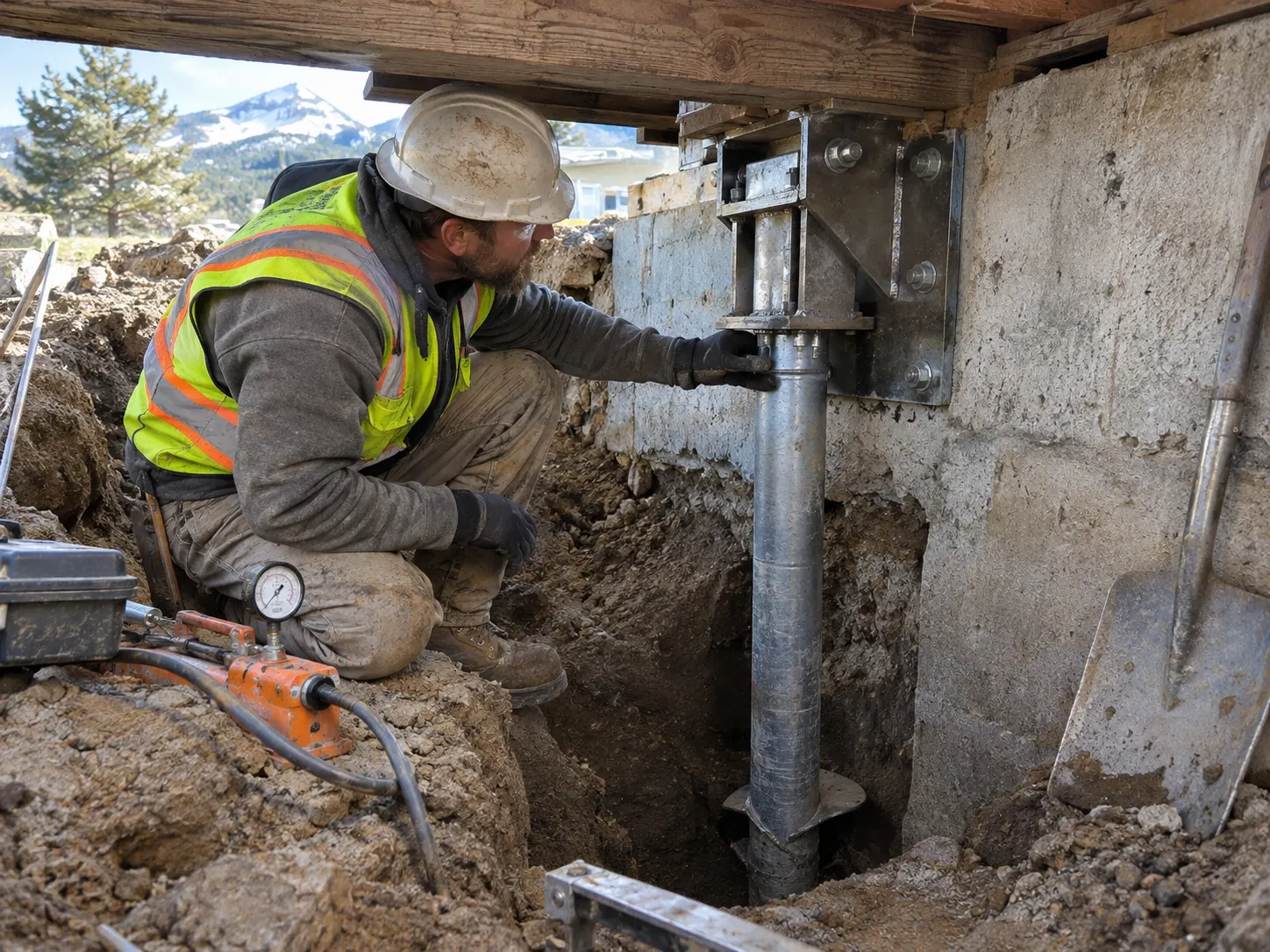
Worker inspecting a helical pier beneath a Colorado home

A helical pier holds a settling foundation in place when its helix sits below the Colorado clay that swells and shrinks, and when it is turned until the torque reaches the number the engineer set. Colorado Helical Pier installs PierTech helical piers and checks the torque on every pier.

303-578-4414

Call us for information

When Helical Piers Fit The Problem

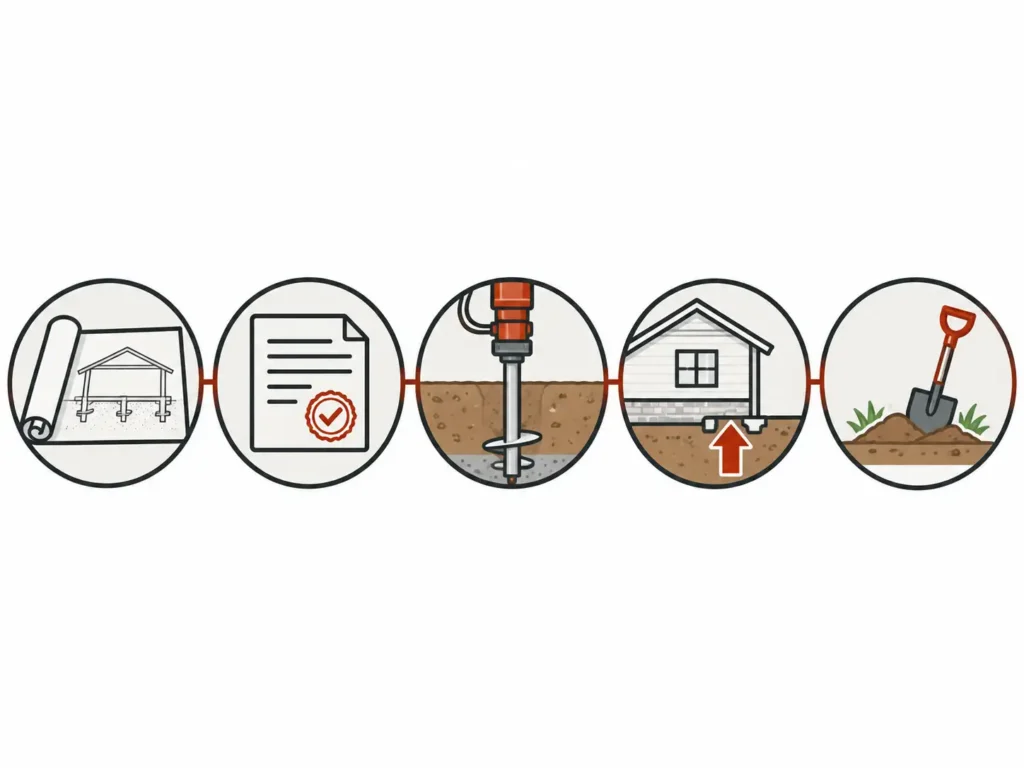
Five-step helical pier foundation repair process showing engineering plans, permits, pier installation, foundation stabilization, and site restoration

Helical piers fix a foundation that is sinking. They are the wrong first fix for a foundation that is rising.

On Colorado’s expansive clay, a helical repair holds when 4 things are true:

  1. The house is moving down, at a corner or along a wall.
  2. The helix ends up below the active zone, the depth of clay that wets and dries with the seasons.
  3. Every pier reaches the torque the engineer set for it.
  4. Roof and irrigation water stays away from the foundation after the repair.

Colorado clay moves hard when it gets wet. The Colorado Geological Survey shows a claystone sample that almost tripled in volume 1 hour after water was added. On an interstate in eastern Colorado, the survey reports as much as 1 foot of uplift from expansive clay, forcing the repair of 2 concrete lanes only 6 months after the paving was finished.

Colorado Helical Pier installs PierTech helical piers under settling foundations from its base in Elizabeth, Elbert County, as part of its foundation repair services. Most residential installs take 1 to 4 days.

Heave is a different problem: what a repair bracket can and can’t hold

A helical repair pier carries the house’s weight down to bearing soil. It doesn’t pin the house to the ground.

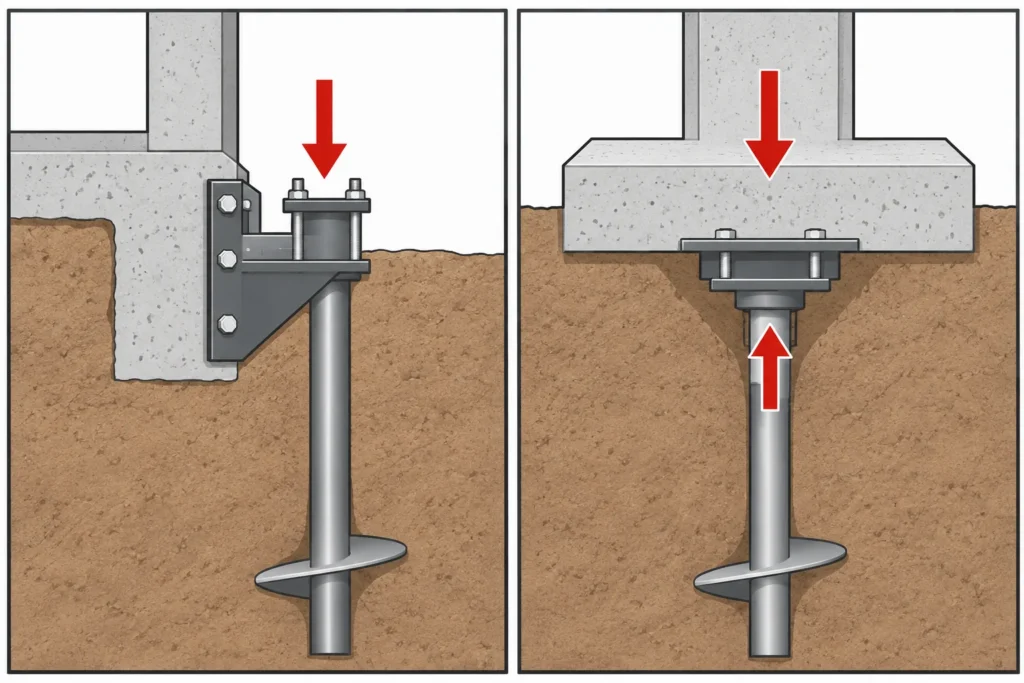
ICC-ES report ESR-3969 shows the difference in its bracket ratings. The Tru-Lift side-load bracket used on existing foundations is limited to compression loads (Section 5.3), with an allowable rating of 27,900 pounds. The new-construction bracket, Type B in the report, is rated for 43,530 pounds in compression and 33,940 pounds in tension (Table 1). Tension is what holds a structure down. A retrofit bracket has no tension rating. When the clay under a footing swells, nothing in that bracket resists the push.

Basement and garage slabs rest on the soil itself. Piers along the walls never touch them, so slabs rise and drop with the clay.

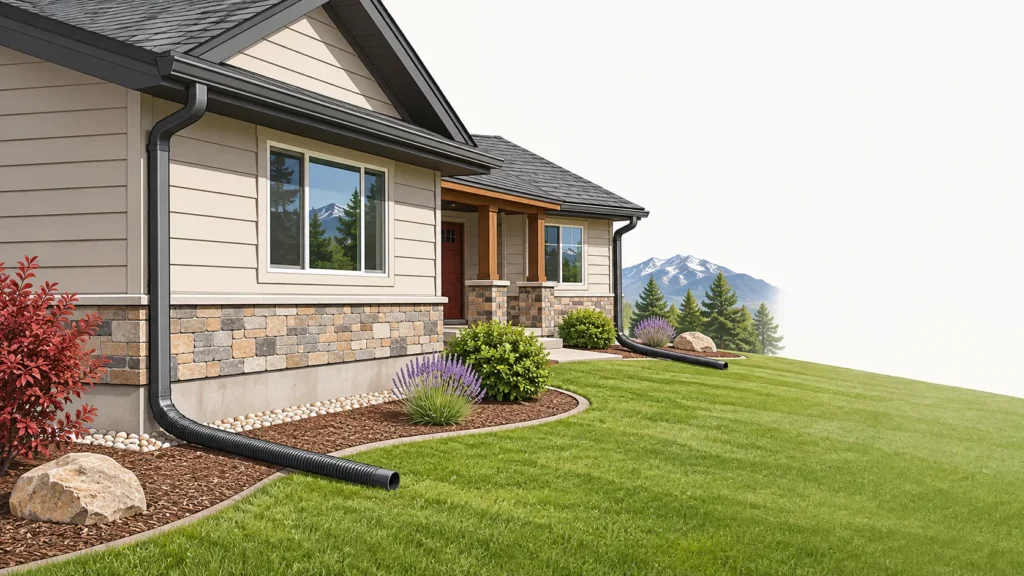
That’s why the first question at your house is direction, and why heave control starts with water. The Colorado Geological Survey lists planting next to the foundation, where irrigation water enters the soil, among the circumstances that make expansive-soil damage worse. For the warning signs of each kind of movement, see signs your home needs foundation repair.

Eco-Friendly and Efficient Helical Pier Products

High-Quality Helical Pier Products

The expansive-clay spec: a single helix and a torque floor

For square-shaft helical piers in expansive soil, the published spec is a single helix plate turned to a minimum installation torque, typically 4,000 ft-lb, or to refusal.

It comes from Design, Specification and Installation of Square Shaft Helical Piers in Expansive Soils, a 2007 paper published by the Deep Foundations Institute. The same spec calls for 1.5- to 1.75-inch square shafts and the manufacturer’s ICC evaluation report number written into the specification. The paper credits more than 20 years of performance monitoring behind the method.

The track record for square-shaft piers in swelling soil is long. A 2006 paper in ASCE’s Geo-Volution proceedings, Performance of Square Shaft Helical Pier Foundations in Swelling Soils, estimated that about 130,000 square-shaft helical piers had been installed since 1986 for repairs and new construction in swelling soils, including the steeply dipping bedrock areas of the Front Range, with no documented failures.

Why A Single Helix

Every helix plate is a bearing plate. A plate that ends up inside the active zone gets pushed upward when that clay takes on water. With a single plate at the tip, below the active zone, swelling clay has only a narrow steel shaft to grip.

Extra plates add capacity in stable soil. In expansive clay, ask the installer where the top plate ends up.

Why Torque Comes Before Depth

Torque is a soil reading taken while the pier goes in. The number climbs as the helix bites into firmer ground, and the crew keeps turning until each pier hits the torque on the plan. A depth written into a quote says nothing about what the helix is sitting in.

Where The Depth Number Comes From

ESR-3969 has the geotechnical report set any minimum pier depth, based on site hazards, frost and expansive soil among them (Section 4.1.1). A 2013 paper by Nelson, Chao, Fox and Dunham-Friel advises assuming the design active zone reaches the full depth of potential heave whenever no water-migration analysis is available. The depth on your plan is the engineer’s call, and the torque reading confirms the soil at that depth.

The Piers We Install

Our repair piers are PierTech helical piles built on a round steel shaft 2-7/8 inches across, evaluated in ICC-ES ESR-3969. The report gives that shaft a torque factor (Kt) of 9 per foot in compression and a maximum installation torque rating of 8,840 ft-lb.

Permits And Engineering For Helical Piers In Colorado

Colorado has no statewide building code, so your city or county sets the permit rules for a helical pier repair.

Colorado’s Office of the State Architect and the International Code Council both state that building codes are adopted and enforced locally. For houses built under the International Residential Code, ESR-3969 lists the PierTech system as an alternative foundation system (Section 2.2). It also requires engineering calculations and drawings prepared by a registered design professional, submitted to the code official for each project (Section 4.1.1).

Our engineering services cover P.E.-stamped drawings, soils report review, load test design and corrosion analysis. Get the permit plan in writing before you sign. A contractor who calls the permit a formality is guessing about your city.

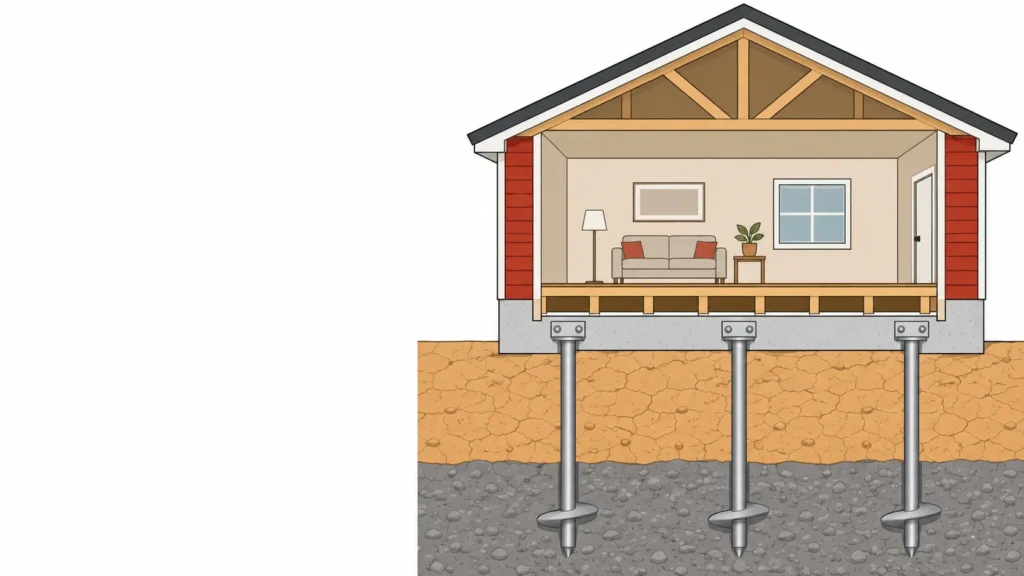
Cross-section of a house supported by helical piers

A Soils Report Can Change The Pier Math

Under C.R.S. 6-6.5-101, a builder must give a new-home buyer the soils analysis summary and site recommendations 14 or more days before closing. If your engineer can rely on a site-specific soils report, ESR-3969 allows a factor of safety of 2 on torque-based capacity instead of 2.5. That’s 25% more design load per pier. HomeGuide puts a geotechnical engineer at $1,000 to $5,000 total on average.

Comparison of helical pier repair and new construction brackets

The Closeout File: 4 Papers To Keep With The House

  1. The engineer’s stamped calculations and drawings
  2. The permit and the final inspection sign-off
  3. The special inspection report, where your city required one
  4. The pier record: pier number, final depth and final torque for every pier

Keep them with your closing documents. Together they’re the record of what’s under the house.

What happens after you sign the quote

Most residential installs take 1 to 4 days on site, winter included, since the piers are turned in rather than poured. The engineering and permit steps come first.

  1. Engineering. A registered design professional prepares the calculations and drawings, which ESR-3969 requires for every project.
  2. Permit. The engineering goes to your city or county with the permit application, and each jurisdiction sets its own review time.
  3. Install. Crews dig a small access pit at each pier and set a Tru-Lift bracket under the footing. Each pier turns down to its design torque, with torque checked on every pier, and special inspection happens here when your city requires it.
  4. Lift and lock. Once the piers reach capacity, we lift where the structure allows. You’ll know the planned amount before work starts.
  5. Backfill. Pits get backfilled and landscaping restored, along with water-management recommendations for your lot.
Testimonials

Check what Our clients say!

At Colorado Helical Pier, we take pride in delivering exceptional services to our clients. Don’t just take our word for it—read what our happy customers have to say about their experience with us!

597

customers have given rating for support

Average rating 5 / 5

How long helical piers last in Colorado soil

ESR-3969’s rated capacities already account for 50 years of corrosion, calculated on bare steel losing 0.036 inch of thickness under ICC-ES acceptance criteria AC358. The report gives galvanized shafts no extra rating for their zinc coating, which leaves the coating as added margin.

The report doesn’t cover soil with resistivity below 1,000 ohm-cm, pH below 5.5, sulfates above 1,000 ppm, high organic content, landfill or mine waste (Section 5.6). Our engineering services include corrosion analysis for sites like that.

Treat any 100-year promise as an estimate.

Want to Get Helical Piles Services?

Choosing between helical and push piers

Helical piers fit most homes and light structures, and they need no house weight to install. Push piers use the house as the counterweight and fit heavy houses with substantial footings where bedrock is shallow. Our guide to push piers for foundation repair in Colorado compares the 2 in detail.

Colorado home with downspout extensions and proper foundation grading

Frequently Asked Questions

Do helical piers stop a house from heaving?

No. They stop settlement. The Tru-Lift repair bracket carries compression only (ESR-3969, Section 5.3), so swelling clay can still lift a footing, and slabs move with the soil. Heave control starts with keeping water away from the walls.


What torque should a helical repair pier reach in Colorado clay?

The engineer sets it from the design load. For square-shaft piers in expansive soil, the 2007 Deep Foundations Institute paper specifies typically 4,000 ft-lb or refusal. On a 2-7/8-inch PierTech shaft, 4,000 ft-lb correlates to 18,000 pounds of allowable capacity with a soils report and 14,400 pounds without one on an IRC house.


Is a single helix better than 2 to 4 on a repair pier?

In expansive clay, the 2007 Deep Foundations Institute paper says yes: its design rules call for single-helix piers only. ESR-3969 allows up to 4 helices on a lead section, and extra plates add capacity in stable soil.


How far apart do helical piers go?

HomeGuide puts typical spacing at 5 to 8 feet. ESR-3969 sets the minimum at 4 average helix diameters center to center, which is 40 inches with 10-inch plates. For expansive soil, the 2007 Deep Foundations Institute paper’s design rules call for maximum spacing and the fewest piers, with each pier carrying its full design load.


What should the pier record show?

Pier number, final depth and final installation torque for every pier. Where special inspection applies, IBC Section 1705.9 adds the installation equipment, pile dimensions and tip elevations.


Does a soils report change the design?

It can. ESR-3969 lets the engineer use a factor of safety of 2 on torque-based capacity with a site-specific soils report, and 2.5 without one on IRC houses.


Will a permitted pier repair matter when I sell?

A permitted repair with stamped drawings and a pier-by-pier record gives a buyer’s inspector something to read. An unpermitted repair gives them questions.

Expert Foundation Solutions

Book An On-site Assessment

Describe what you’re noticing and give us the address. Residential repairs are booked by region, and we’ll reply to schedule the visit. The written quote that follows shows the pier count, where each pier goes, how deep and what it carries, and you’re under no obligation.

Cart

No products in the cart.