Commercial & residential helical pier installation—ICC-ES certified for projects of any size.

Colorado Helical Pier: New Construction & Foundation Repair Solutions

Office Hours: 08:00am-6:00pm

Screw Foundation Piles In Colorado

  • Home
  • Screw Foundation Piles In Colorado
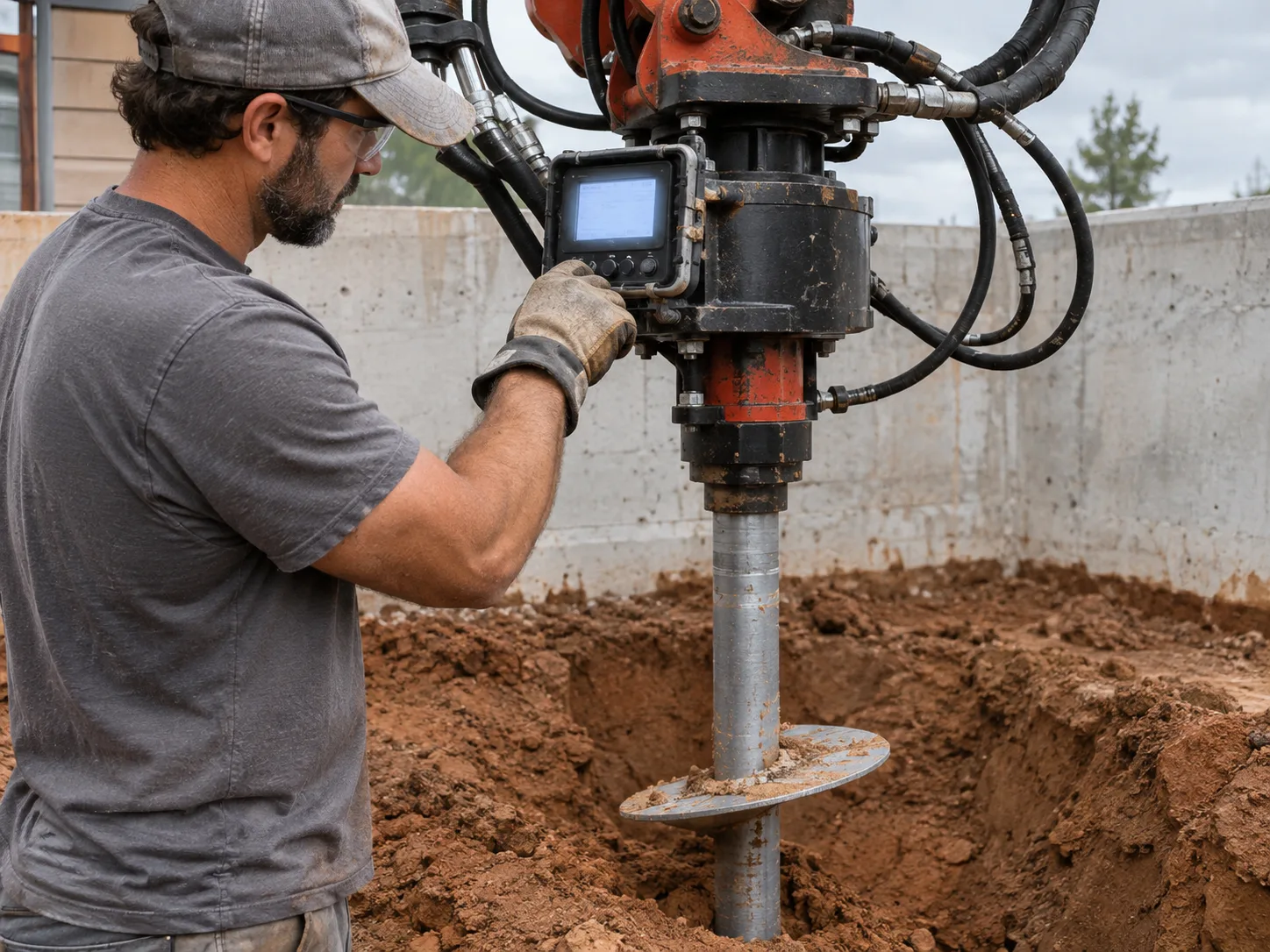
Installer monitoring installation torque on a screw pile drive head

A screw foundation pile is a steel shaft with helix plates near its tip. A hydraulic drive turns it into the ground until it reaches a torque target, and the final torque reading is the field check on the soil capacity the pile has reached. We install PierTech’s 2-7/8-inch round-shaft system, which ICC-ES evaluated under report ESR-3969, for repairs, additions, decks and new construction across Colorado.

303-578-4414

Call us for information

Screw piles and helical piles are the same system

Screw pile, helical pile, helical pier and helical anchor all name the same steel screw-in foundation system. Our helical piers and piles product page lists anchors, piles and screw piles as other names for helical piers.

Whatever a bid calls them, get 2 things in writing: the manufacturer’s evaluation report number and the torque target for each pile. Those 2 lines tell you what the steel is rated for and how the crew will check it in the ground.

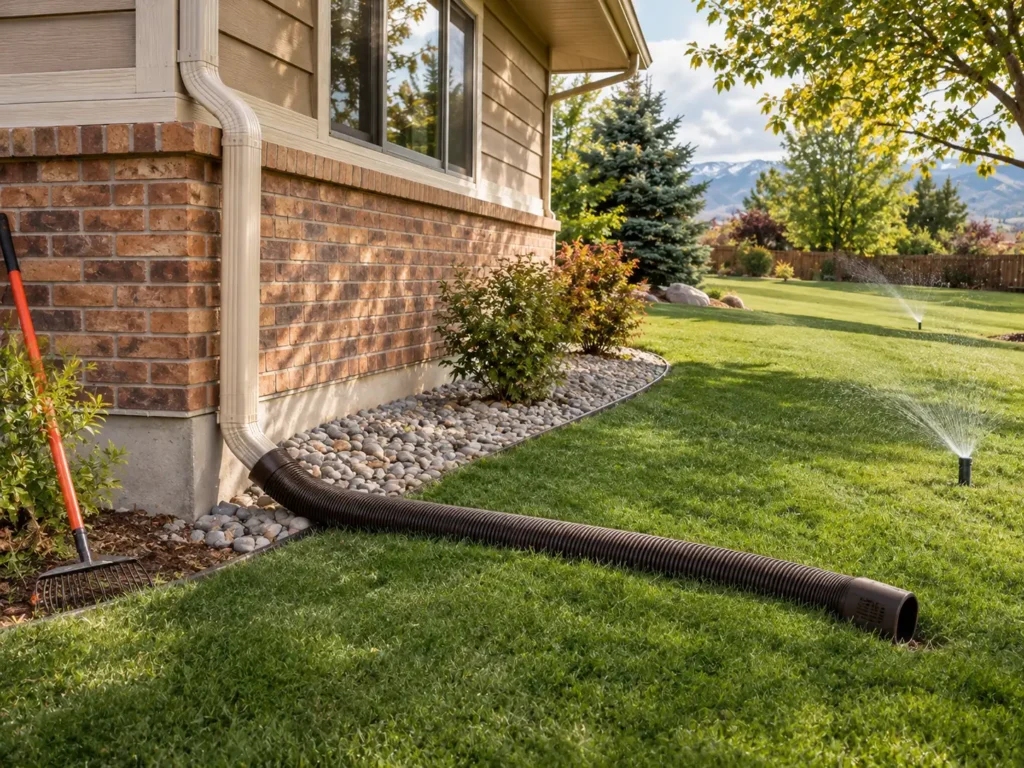
Colorado home with downspout extension, gravel drainage strip, and lawn sprinklers

What Colorado clay changes about a screw pile

Expansive clay is one of the main inputs to how deep the helix plates sit. The Colorado Geological Survey (CGS) says expansion accounts for nearly all expansive-soil damage in the state, and it describes problems in garage and basement floor slabs as “very common indicators of expansive clay throughout the state.”

The swelling isn’t even. In a southwest Denver subdivision built on the Pierre Shale, thin bentonite beds swelled 39% to 43% in lab tests, while the claystone around them swelled 2% to 8% (Gill et al., Clays and Clay Minerals, 1996). A 2005 study of a subdivision near Denver found heave damage lined up with steeply tilted, bentonite-bearing claystone and faded to small or negligible where 10 feet or more of soil covered that bedrock (Noe, Journal of Geotechnical and Geoenvironmental Engineering).

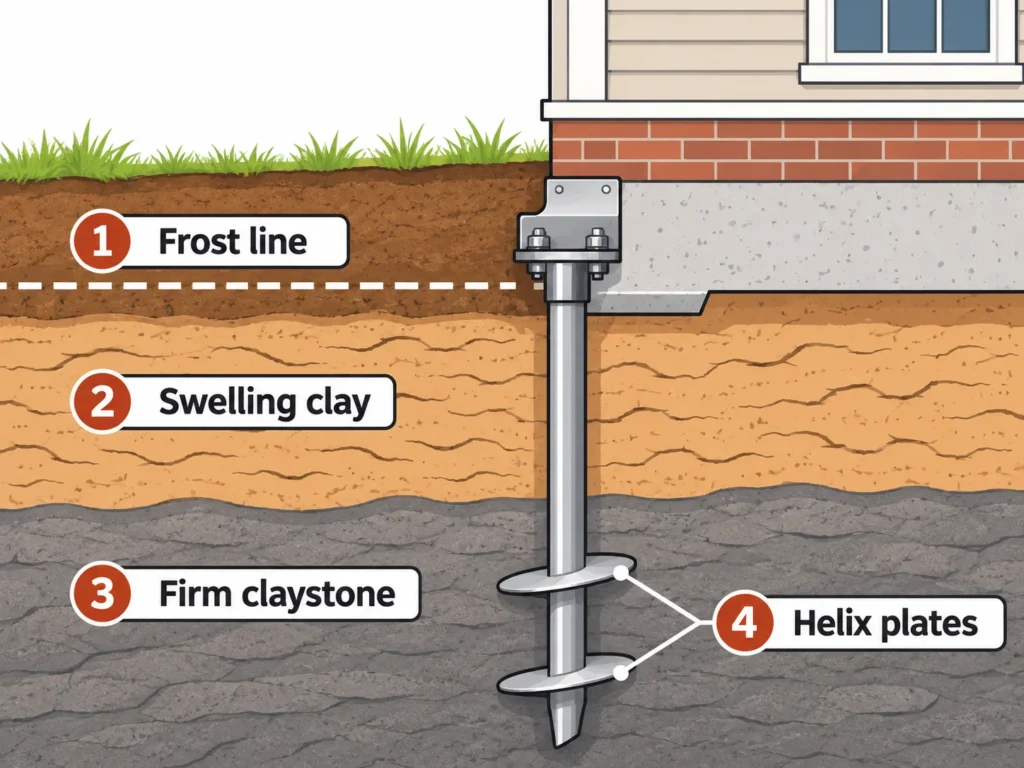
That’s why depth is a design item. ESR-3969 has the geotechnical report state any minimum pile depth that local hazards such as frost and expansive soils require. On new foundations, the gap under the grade beam matters too: CGS names inadequate void space between soils and grade beams among the conditions that make swelling damage worse.

Eco-Friendly and Efficient Helical Pier Products

High-Quality Helical Pier Products

Cross-section of a helical pier extending through swelling clay into firm claystone below the frost line

How deep screw piles go in Colorado

Your engineer sets each pile’s minimum depth with frost and expansive soil in mind, and the pile keeps turning until it reaches its torque target.

Published frost depths for footings:

  • Arvada: 36 inches
  • Douglas County: 36 inches
  • Elbert County: 36 inches

Denver, the Pikes Peak region and other jurisdictions publish their own values, so check the design criteria for your address.

Piles loaded in tension, where the load pulls up on the pile, carry an extra rule. ESR-3969 requires the helix to sit at least 12 helix diameters below the ground surface in tension applications. A 10-inch plate in tension needs at least 120 inches, or 10 feet, of cover. Shallower installs need a site-specific design from a registered design professional.

How torque turns into rated capacity

Final installation torque is the field measure of soil capacity. ESR-3969 publishes a torque correlation factor, Kt, of 9 per foot in compression and 8 per foot in tension for PierTech’s 2-7/8-inch shaft. Multiply final torque by Kt to get ultimate capacity, then divide by a factor of safety.

Say the gauge reads 5,000 ft-lb at final depth. Ultimate capacity is 5,000 x 9, or 45,000 lb. ESR-3969 allows half of that, a factor of safety of 2.0, so the allowable soil capacity is 22,500 lb. On residential work designed under the IRC without a site-specific geotechnical report, the report requires a factor of safety of 2.5, which cuts the allowable soil capacity to 18,000 lb.

The math has ceilings. ESR-3969 caps installation torque on this shaft at 8,840 ft-lb, which limits allowable soil capacity to 39,800 lb in compression at a factor of safety of 2.0, or about 31,800 lb at 2.5. Brackets carry their own ratings: 27,900 lb allowable for the Type A side-load repair bracket and 43,530 lb for the Type B direct-load bracket. The lowest rating in the system governs.

A special inspector records the equipment, pile size, tip elevation, final depth and final torque for each pile while the crew installs it, as IBC Section 1705.9 and ESR-3969 require. Keep that record with your house papers.

Permits, engineering and inspections across the Front Range

Plan on a permit and an engineered design. ESR-3969 requires engineering calculations and drawings from a registered design professional for each project, submitted to the code official for approval, plus continuous special inspection during installation.

Code cycles and local rules differ by jurisdiction:

  • Denver enforces the 2025 Denver Building and Fire Codes, based on the 2024 I-codes and effective December 31, 2025.
  • Arvada adopted the 2024 code set on March 24, 2026.
  • Douglas County’s presubmittal handout for its 2024 codes lists the 2024 IBC.
  • Elbert County’s remodel checklist requires a State of Colorado licensed engineer to inspect items including open holes, pier and caisson placement, footing size and steel, foundation walls and perimeter drains.
  • The Pikes Peak Regional Building Department works under the 2023 Pikes Peak Regional Building Code.

ESR-3969 is evaluated against the 2009 through 2021 editions of the IBC and IRC. Denver, Arvada and Douglas County now work from 2024-based codes, so the plan reviewer decides how the report applies.

Our engineering support team reviews geotechnical reports, prepares engineered drawings, designs load test frames and handles P.E.-stamped projects.

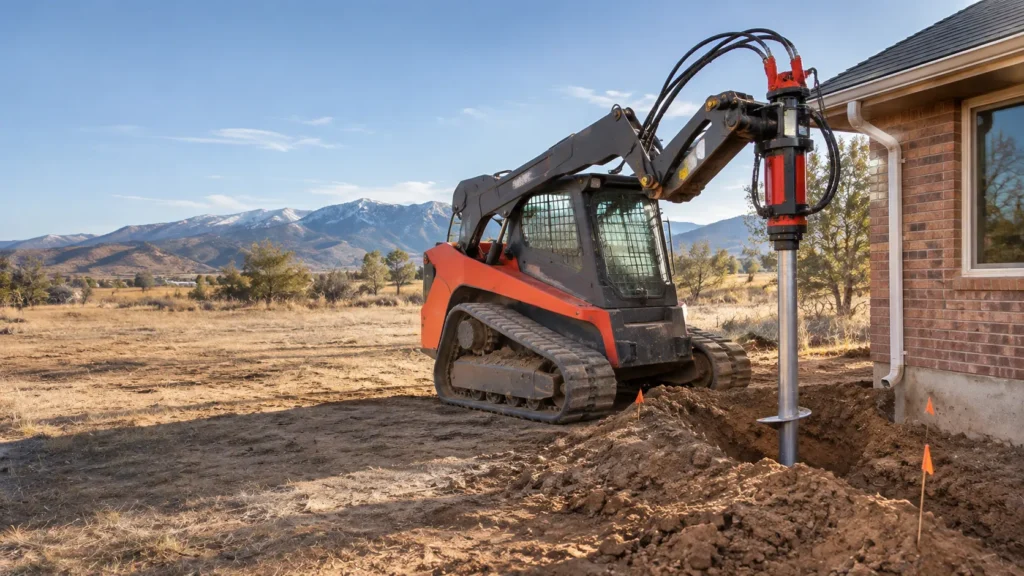
Compact track loader installing a steel helical pier beside a Colorado home

Find your home’s soils report before anyone drills

If you bought your home new, your closing file may hold the soils information an engineer wants first. Colorado law (C.R.S. 6-6.5-101) requires a builder to give the buyer of a new home a summary of the soils report and site recommendations at least 14 days before closing. Where a “significant potential for expansive soils” is recognized, the builder also has to supply a publication on those soils, the building methods used and how to care for the house.

CGS says its guide SP-43, A Guide to Swelling Soils for Colorado Homebuyers and Homeowners (2nd edition, 2007), satisfies part of that state disclosure requirement, so look for it in the same folder. Hand both to your engineer.

Want to Get Helical Piles Services?

When the floor heaves, fix the water first

As our push pier guide explains, push piers correct settling but can’t stop heave, since a basement slab usually isn’t attached to the footing beside it. CGS lists inadequate management of surface drainage among the conditions that make swelling damage worse, so start with water control.

The numbers come from the ASCE Geo-Institute’s homeowner guide to shrink-swell soils, Colorado State University Extension and the IRC:

  • Slope the soil away on every side. IRC Section R401.3 calls for at least 6 inches of fall within the first 10 feet, and the ASCE guide calls for at least 3 inches in 5 feet.
  • Discharge gutters and downspouts at least 3 feet from the foundation (ASCE), and leave downspout extensions in place (CSU Extension).
  • Keep sprinkler lines, valves and heads at least 5 feet from the foundation (ASCE), and keep spray at least 5 feet away (CSU Extension).
  • Plant at least 5 feet from the foundation unless the plants have “very low water requirements,” and keep trees at least 15 feet away (CSU Extension).
  • Track concrete floor cracks. The ASCE guide lists cracks 1/16 inch across or wider among the signs of shrink-swell movement.

Ask for piers and drainage as separate line items on any bid. Then you can see what each one fixes.

Testimonials

Check what Our clients say!

At Colorado Helical Pier, we take pride in delivering exceptional services to our clients. Don’t just take our word for it—read what our happy customers have to say about their experience with us!

597

customers have given rating for support

Average rating 5 / 5

Screw piles for decks and porches

Screw piles suit additions, decks, porches and sunrooms because the torque reading confirms their capacity, while push piers need a structure heavy enough to push against. Our push pier guide explains why a deck rarely weighs enough for push piers.

HomeGuide prices installed deck piers at $300 to $500 each. Your engineer still accounts for the local frost depth, 36 inches in Arvada, Douglas County and Elbert County, and piles approved under ESR-3969 still need an engineered design. See our residential and deck work.

Frequently Asked Questions

Are screw piles and helical piles the same thing?

Yes. Screw pile, helical pile, helical pier and helical anchor name the same steel screw-in foundation system, and our product page lists screw piles among the other names for helical piers.


What frost depth applies to my address?

Your building department sets it. Arvada, Douglas County and Elbert County publish 36 inches. Denver, the Pikes Peak region and other jurisdictions publish their own values.


Who inspects a screw pile installation?

A special inspector, continuously, while the piles go in. ESR-3969 requires it under IBC Section 1705.9, and the record covers equipment, pile size, tip elevation, final depth and final torque. Elbert County also requires a State of Colorado licensed engineer to inspect items such as pier placement.


Do deck screw piles need an engineer?

When the piles are approved under ESR-3969, yes. The report requires engineering calculations and drawings from a registered design professional for each project, approved by the code official.

Expert Foundation Solutions

Get A Screw Pile Assessment For Your Site

Send photos and the project address. We visit before we quote, because pier count, depth, access and engineering all set the price.

Cart

No products in the cart.