Commercial & residential helical pier installation—ICC-ES certified for projects of any size.

Colorado Helical Pier: New Construction & Foundation Repair Solutions

Office Hours: 08:00am-6:00pm

Helical Piles In Colorado

  • Home
  • Helical Piles In Colorado
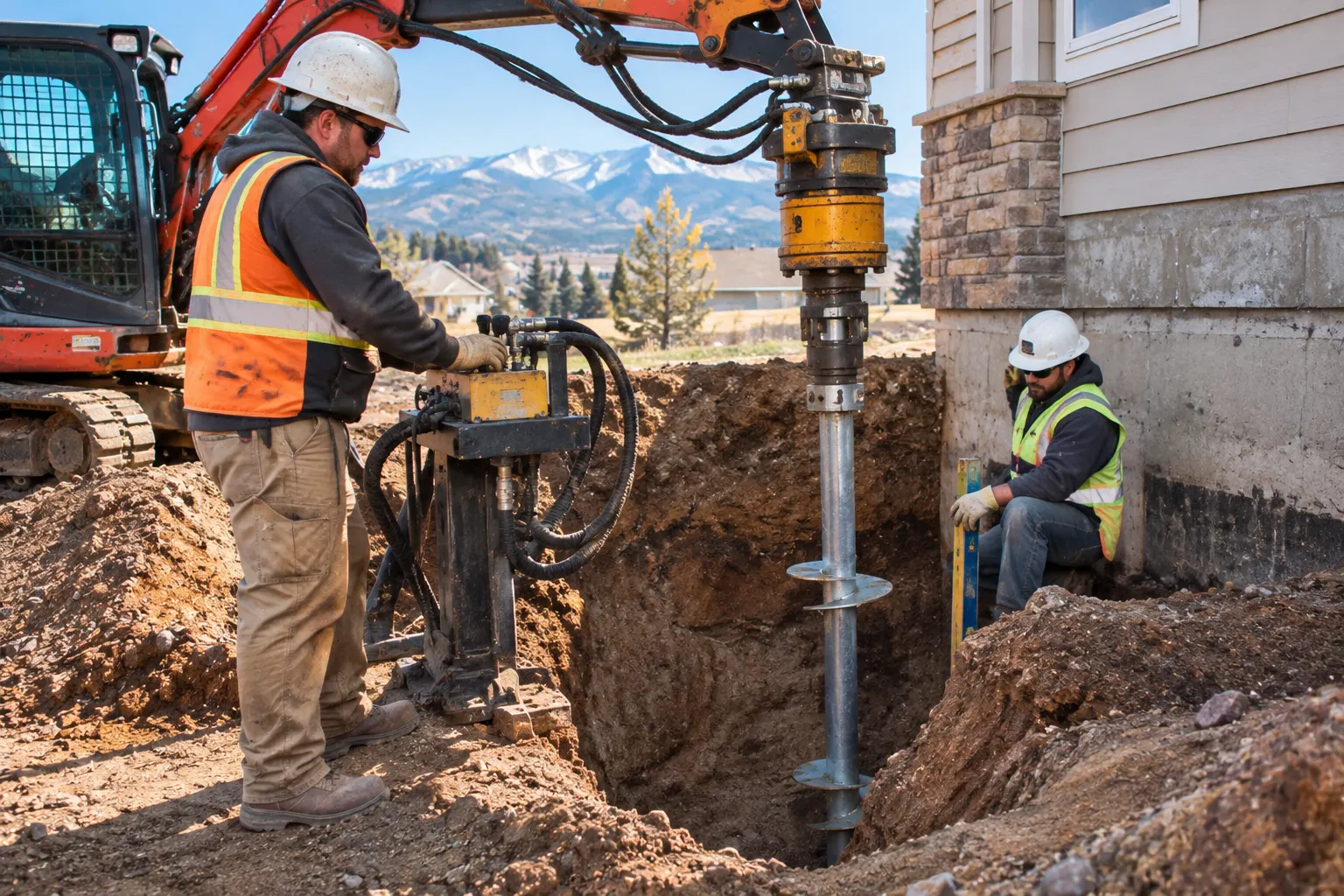
Crew installing a helical pier with a hydraulic torque motor at a Colorado home

Colorado Helical Pier installs PierTech helical piles under settling foundations, new homes, additions, decks and commercial buildings across Colorado. Every pile turns down through the clay that swells and shrinks with the seasons, and it stops only when its torque proves the load it was designed for, under the rules in ICC-ES report ESR-3969. Most homes are finished in 1-4 days.

303-578-4414

Call us for information

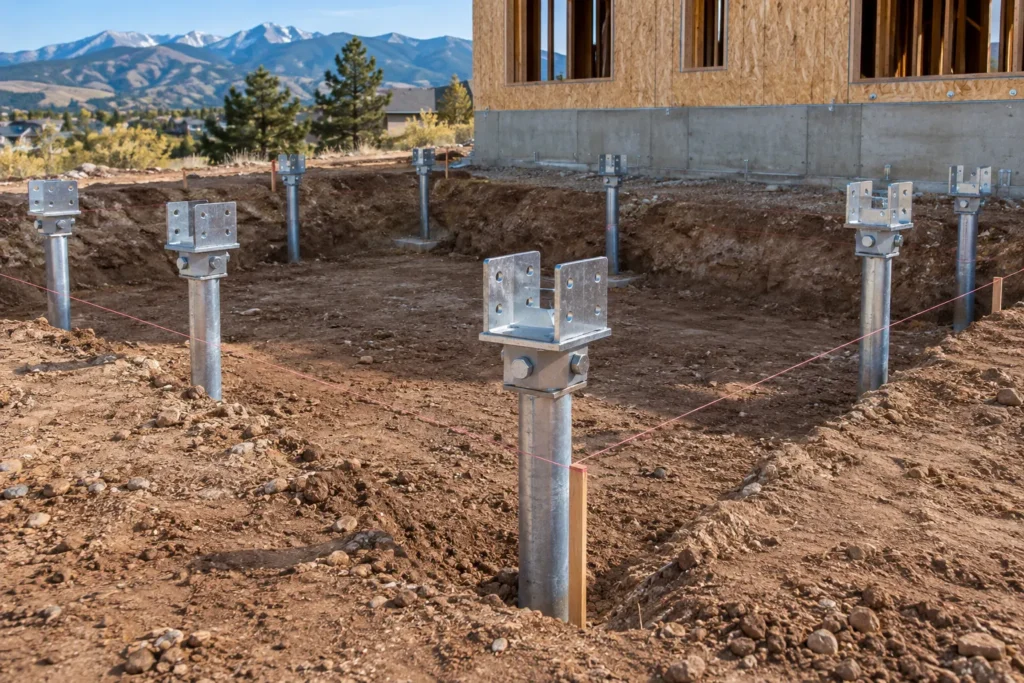
Helical piles with direct-load brackets set for a new footing in Colorado

How Deep Helical Piles Go In Colorado

There’s no fixed number. A helical pile keeps going down until 2 conditions are met: its installation torque proves the design load, and it has passed any minimum depth written into the soils report. ESR-3969 requires both before a pile counts as finished.

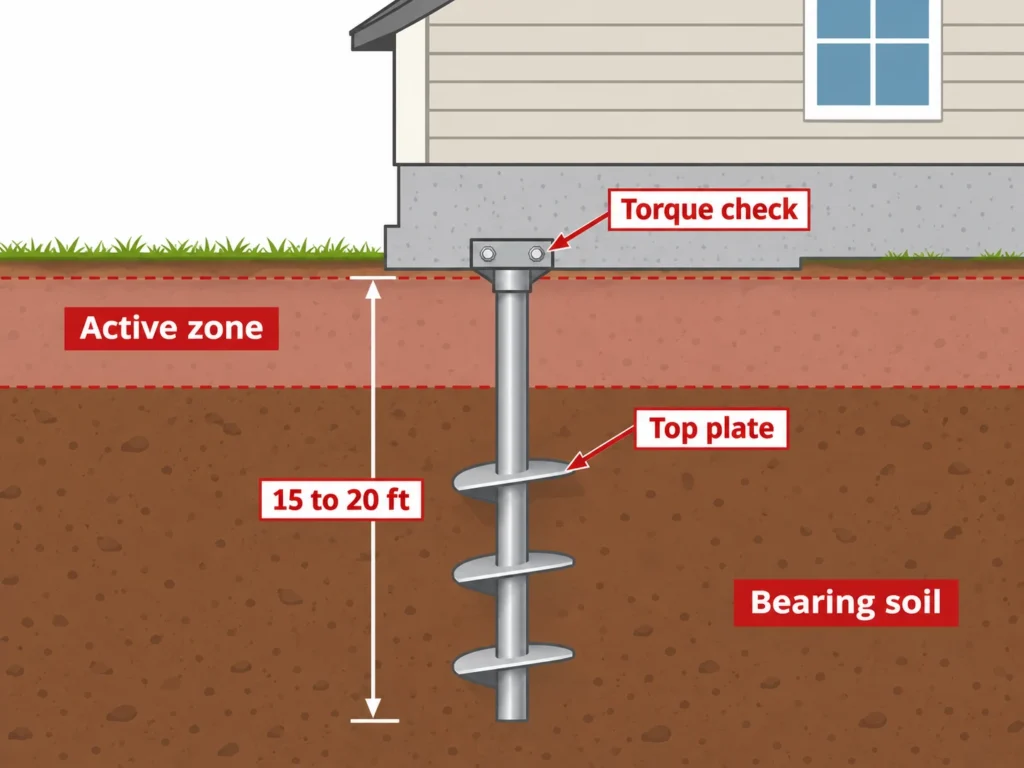
That minimum depth matters on Colorado clay because the clay only causes trouble in the band of soil that gains and loses water. Engineers call that band the active zone. A Colorado State University study at a Fort Collins test site (Durkee, 2000) found that common practice treats the active zone as 15 to 20 feet deep or less. The same study measured moisture rising to about 18 feet under a slab, and its model of long-term lawn irrigation pushed the zone toward 35 feet.

So read the depth on any quote as an estimate. The torque gauge sets the real number, pile by pile. Which is why 2 piles on the same house can finish at different depths.

Another detail moves the number. On a lead section with 2 or more helix plates, ESR-3969 spaces the plates 3 times the bottom plate’s diameter apart. With an 8-inch bottom plate, a 3-plate lead carries its top plate 4 feet above the bottom one. The plates carry the load, so ask where the top plate finishes as well as the tip.

What The Torque Reading Proves, In Numbers

Torque converts to capacity through a fixed factor. For the 2-7/8 inch PierTech shaft we install, ESR-3969 sets that factor (Kt) at 9 per foot in compression and 8 per foot in tension.

Say a pile finishes at 4,000 ft-lbs. Multiply by 9 and the report credits it with 36,000 lbs of ultimate capacity. The working number gets cut on purpose:

  • With a site-specific geotechnical report, ESR-3969 divides by 2.0, so that pile carries 18,000 lbs.
  • Without one, a house designed under the residential code uses a factor of safety of 2.5, and the same pile carries 14,400 lbs.
  • The shaft tops out at 8,840 ft-lbs of installation torque, which works out to 39,800 lbs allowable.
  • On a repair, the Tru-Lift side-load bracket is rated for 27,900 lbs in compression, so the bracket caps the pier even when the soil proves more.

That’s the math behind the pier count on your quote: the load along each wall, divided by what each pile proves, never above what the bracket allows. It’s also why a soils report earns its keep. The same 4,000 ft-lb pile is credited with 25% more load when a site-specific report backs the design, so bring any report you have to the assessment and we’ll review it there.

Before the crew leaves, ask for the final torque and depth of every pile. Those 2 numbers are your proof.

Eco-Friendly and Efficient Helical Pier Products

High-Quality Helical Pier Products

What Helical Piers Fix, And What They Leave Alone

Helical piers stop a foundation from settling. On a repair they won’t hold a rising foundation down, and they never touch a basement slab that floats free of the walls.

The bracket explains the first limit. ESR-3969 restricts the side-load bracket used on repairs to compression loads. It catches a footing that’s dropping and parks it on the pile. It has no tension rating, so it can’t pull a heaving footing back down. That’s why the first question at an assessment is the direction of movement, and our guide on how settling and heaving differ on Colorado clay walks through the signs.

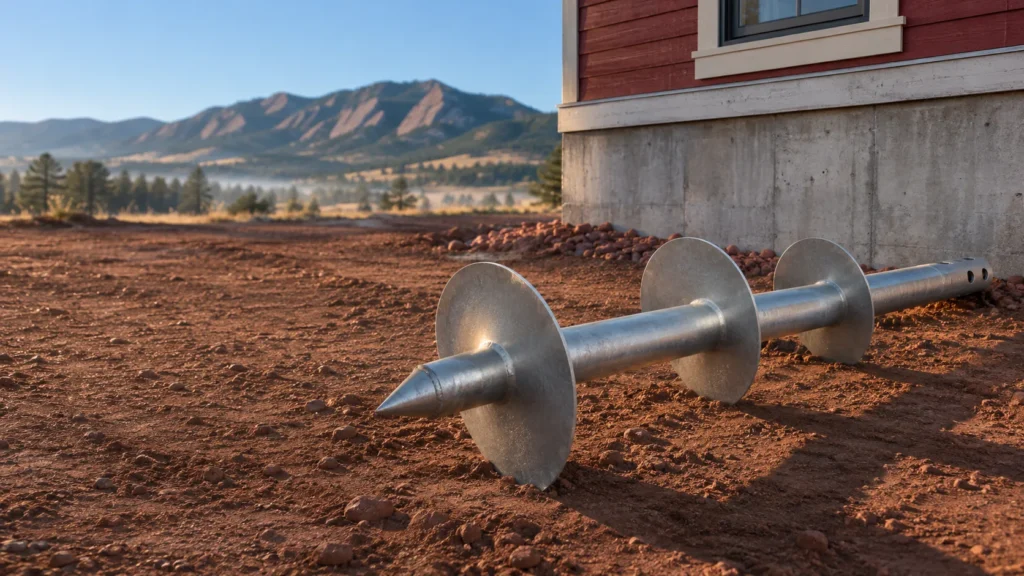
Galvanized helical pile with 3 helix plates on Colorado clay beside a home foundation

The rest of what a pier job won’t solve, and what we do about each:

  • A basement slab that floats on the soil, with no tie to the footing, sits out of reach of any pier under the wall.
  • Piers stop the house from riding the clay, but they don’t stop the clay from swelling. A homeowner who watches the cracks close can think the job’s finished, and you still have water to manage. The residential code (IRC R401.3) wants the ground to fall at least 6 inches within the first 10 feet away from the foundation, and every job ends with our water-management recommendations for the house.
  • ESR-3969 doesn’t cover corrosive soil, meaning soil resistivity below 1,000 ohm-cm or a pH below 5.5. On ground like that, ask for a corrosion analysis before any steel goes in. Our engineering team runs them.
  • Rock changes what torque means. A torque reading stands for capacity only while the pile advances, about 3 inches per turn under ESR-3969. On hard rock the pile can stall or skate, and the gauge stops measuring anything useful. When the bearing layer sits close to the surface, push piers can be the better fit, and steep rock calls for an engineered end-bearing design.
  • Lift has a limit. Once the piers reach capacity, we can raise a settled foundation back toward level. How far is safe depends on the walls and finishes, and you get that number before we start.

New construction is the exception to the first limit. The direct-load bracket cast into a new footing or grade beam carries ESR-3969 ratings of 43,530 lbs in compression and 33,940 lbs in tension, so a new building can be anchored against uplift from swelling clay. If your house is settling now, our foundation repair service across Colorado covers the full job.

Diagram of a helical pile passing the active clay zone with its top helix plate in bearing soil

Why A Slim Steel Shaft Gives Swelling Clay Less To Grab

Wet clay grips whatever passes through it and drags it upward as it swells. The less surface a pile shows the clay, the less the clay can pull.

Run the geometry for 1 foot of shaft. A 10-inch drilled concrete pier presents 377 square inches of surface to the soil. The 2-7/8 inch steel shaft we install presents 108, about 3.5 times less. The Colorado Geological Survey lists the wrong depth or diameter of a drilled pier among the causes of damage on expansive soil.

The Front Range has decades of field use behind the idea. In a paper for the 2006 ASCE Geo-Volution seminar in Denver, John S. Pack estimated that about 130,000 square-shaft helical piers had gone into the swelling soils and steeply dipping bedrock areas of the Front Range since 1986, for repairs and new construction, with no documented failures.

Read that record for what it is. It covers square shafts, which show 72 square inches per foot, and it runs through 2006. The round shaft we install shows more surface than those and about 29% of what a 10-inch concrete pier shows. We cite the record for the principle and don’t claim it as our own.

Want to Get Helical Piles Services?

Colorado ground changes by region, and so does the pile plan

The Colorado Geological Survey places most of Colorado’s homes, schools, commercial buildings and roads in areas of potentially expansive clay. What sits under your lot still depends on the region.

Denver Metro And The Front Range Plains

On the plains, Fort Collins and Greeley south through Denver, Castle Rock, Parker, Colorado Springs and Pueblo, the design question is depth: get every helix plate below the ac

Jefferson County Foothills Along The Hogback

West of Denver the bedrock tilts. Jefferson County maps a Designated Dipping Bedrock Area where claystone layers dip 30 to 90 degrees and swelling bedrock can raise ridges up to 2 feet high and hundreds of feet long. The county’s guide, revised August 2024, says damage typically shows up within about 10 years of development. Remedial structural repairs there may trigger special Building Safety review, and the guide suggests buyers of existing homes get an engineer’s evaluation.

Steep rock is where torque stops telling the whole story. A 2024 Deep Foundations Institute conference paper by Melinda Hummel and Howard Perko, Ph.D., P.E., author of the Wiley textbook Helical Piles and an adjunct professor at Colorado State University, is devoted to Colorado geology and end-bearing helical piles on bedrock. On these lots, plan on an engineered design instead of a torque number alone.

Western Slope River Valleys

Over the mountains, the soil can fail the opposite way. The Colorado Geological Survey maps collapsible soils along the Roaring Fork corridor near Glenwood Springs, the Colorado River near Rifle and the Uncompahgre Valley near Montrose. These dry, loose soils can lose 10 to 15% of their volume when they get wet, and the Survey has documented settlement of more than 6 feet. Lawn watering and leaking water lines set off most of it. A pile here has to pass through the collapsible layer to ground that holds when it’s soaked.

We book residential repairs region by region, while commercial and new-construction crews travel to any part of the state. Our crews run out of Elizabeth in Elbert County and cover Fort Collins, Loveland, Greeley, Longmont, Boulder, the Denver metro, Parker, Castle Rock, Colorado Springs, Pueblo, Grand Junction, Glenwood Springs and Durango.

Testimonials

Check what Our clients say!

At Colorado Helical Pier, we take pride in delivering exceptional services to our clients. Don’t just take our word for it—read what our happy customers have to say about their experience with us!

597

customers have given rating for support

Average rating 5 / 5

The paperwork that follows a pier repair when you sell

Colorado’s seller disclosure form asks about this work directly, so start the file on install day.

The Colorado Real Estate Commission’s residential Seller’s Property Disclosure (form SPD19, for use from January 1, 2026) asks whether structural supports or reinforcements were ever added and whether the foundation ever settled, moved, cracked or heaved. It asks about non-aesthetic alterations made without a building permit, and whether written soils or engineering reports exist. A permitted repair with records gives a clear answer to each line.

Keep these together:

  • Your written plan and quote, listing how many piers, where each one goes, the estimated depth and the capacity.
  • The final torque and depth of each pile.
  • Permit and inspection sign-off, where your building department required them.
  • Any P.E. stamped drawings.
  • The soils report from the original build, if there is one.

Your city or county decides whether a pier job needs a permit, and the answer isn’t the same everywhere. If the house was new when you bought it, the builder owed you a soils summary before closing under C.R.S. 6-6.5-101, so check your closing file.

Helical piles for new homes, additions, decks and commercial sites

On new work the piles go in before anything else, and the structure is tied to them.

  • Decks, porches, sunrooms and additions go on piles instead of poured footings, so the framing crew can follow right behind the pile crew. More on helical pile footings for decks and additions.
  • For a new home, the direct-load bracket at the top of each pile, cast into the new concrete, carries the tension rating listed above, so the design can hold the house down against swelling clay as well as hold it up.
  • Commercial and industrial jobs get the same torque checks, and the PierTech Hercules large-diameter pile covers heavier loads. See our commercial and industrial helical pile work.
  • If your crew installs its own piles, we sell the same PierTech hardware we install: push piers, Hercules piles, helical piles and brackets.

Have plans and any soils report ready when we call back. Our engineering team reviews geotechnical reports and designs foundations to the project’s loads and soil conditions.

What happens after you request an assessment

You get a written plan before anyone digs.

  1. Start with a 10-minute call. Tell us what you’re seeing or planning and where the property is.
  2. We visit the site, check which way the structure is moving and go through any reports you have. If piers are the wrong tool, you hear it at the visit.
  3. You get a written plan and quote: the number of piers, their locations, estimated depth and capacity, plus P.E. stamped drawings when a building department, lender or insurance carrier asks for them.

Install day. The crew digs a small access pit at each pier, turns the piles down to their torque target, sets the brackets, lifts where the plan calls for it and backfills. Most homes take 1-4 days, winter included.

Frequently Asked Questions

How deep do helical piles go in Colorado?

Until the torque proves the design load and the pile is past any minimum depth in the soils report. The crew keeps adding extension sections untill both are true. Colorado engineers commonly plan around an active zone of 15 to 20 feet or less, and a Colorado State University study measured moisture rising about 18 feet under a slab, so the depth on a quote is an estimate and the gauge decides.


How many helical piles does a house need?

The count comes from the load along each wall divided by what each pile proves, kept under the bracket rating. Spacing has a floor too: ESR-3969 keeps axially loaded piles at least 4 helix diameters apart, center to center, so 14-inch plates need at least 56 inches between piles. Nobody can give you a real count over the phone, which is why it shows up in the written plan.


Will helical piers stop my basement floor from heaving?

No. A floating basement slab rests on the soil, seperate from the footing, and a pier set under a wall has no connection to it. Slab heave is a whole nother job. It comes down to keeping water away from the clay, with grading that falls away from the house and downspouts that discharge well clear of the foundation.


Do I need a soils report before helical piles go in?

Not always. For a house designed under the residential code, ESR-3969 lets the torque method stand without a site-specific geotechnical report, provided the design uses a factor of safety of 2.5. With a report, the factor drops to 2.0 and every pile is credited with more load. Commercial projects under the building code need a geotechnical report for each site.


What equipment installs a helical pile?

A hydraulic torque motor turns the pile into the ground while the operator watches the torque reading. The rig is light and works from small access pits beside the foundation. There’s 2 things it never does: push against your house during install, or wait on concrete to cure.


Do I have to disclose helical piers when I sell in Colorado?

Plan on it. The 2026 Colorado seller disclosure form asks whether structural supports or reinforcements were ever added and whether alterations were made without a building permit. Talk to your agent about the wording. A permitted job with a written plan and torque records makes the answer simple.

Expert Foundation Solutions

Get The Pier Count, Depth And Capacity In Writing

A site visit tells you whether the structure is settling or heaving and whether helical piles are the right tool for it. There’s no obligation.

Cart

No products in the cart.